

My Parents: 1946
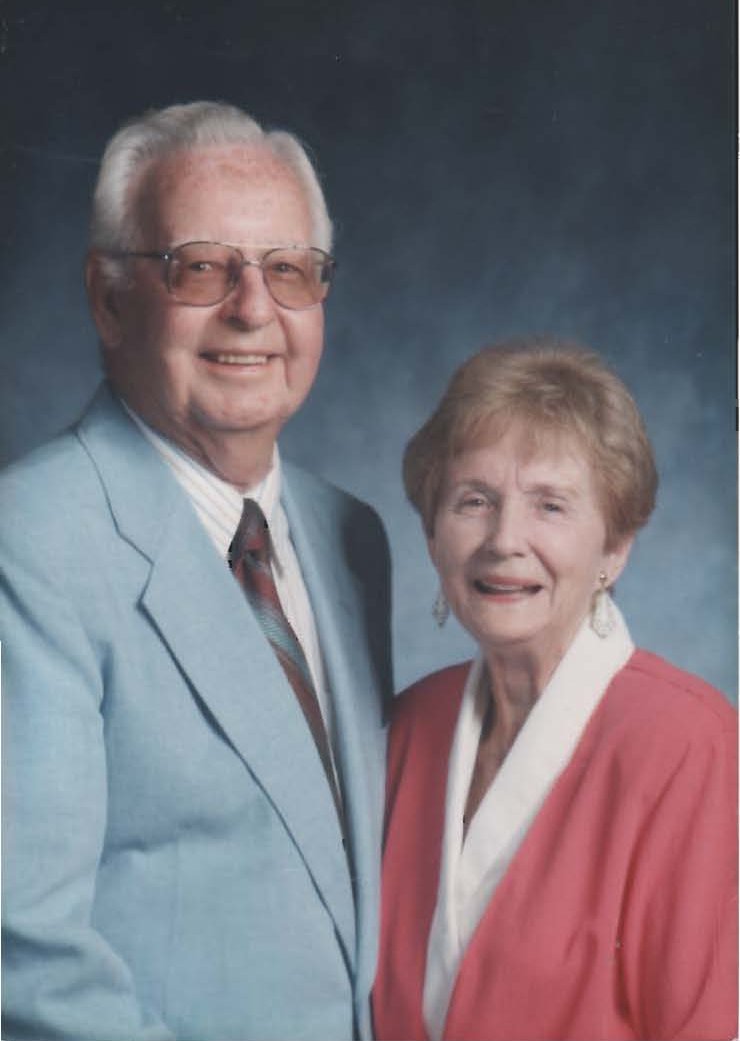
My Parents: 1996
Dear Readers,
My father had not always been a gentle and patient man — not, that is, before my mother gradually slipped into the abyss of Alzheimer’s. You have, perhaps, heard of the “blessings of Alzheimer’s.” I will explain:
My mother suffered, for at least five decades, from a sad loss. I knew, of course, that death was tragic but her loss was not tied to a death, unless it was the death of a dream. Now I know, too late, that the death of a dream is, indeed, a deep loss.
If I had been more mature, I would have helped her to carry that burden. But, alas, I was selfish: I wanted my mother to enjoy the life that she had been given, instead of focusing on what she had lost. I yearned to know my “whole” mother, as she must have been, before the loss had touched her. I resented the intrusion of her grief, which ebbed and flowed.
A few years before her death, the fog of Alzheimer’s gradually enshrouded her memory. Thus, she was able, finally, to release her sorrow. Evidently, she simply forgot the circumstances that were tied to her grief. We [her children] never breathed a word of those circumstances, so afraid were we that she would remember and, once again, take up the old burden.
It was then that my mother began to repeat stories and we braced ourselves, when she asked us: “Have I ever told you-all the story about Clyde Dunn?”
It was two years before my mother’s death and I perfectly remember the setting: We were dining at Osaka’s Japanese Restaurant in Tallahassee. Present were my parents, my husband, my son, my daughter, my future son-in-law, and myself.
When my mother asked us if we had heard the story, I groaned inwardly and said to myself, “Only 50 times.” My father, I was certain, had heard the same story 100 times. However, he smiled gently, patted her hand, and entreated her, “You tell it, Peg; it is a good story.” [The story is below.]
I was never quite so proud of my father as I was at that moment. He was teaching us how to honor my mother, during the “long goodbye” of Alzheimer’s.
Every one of us desires, before death, to know that his or her life was significant — that it mattered. My mother loved to tell that story, I suppose, because it reassured her that her life had contained worth and meaning. Goodness knows, I was woefully — and now painfully — inadequate in giving her that reassurance.
Mother’s Day and Father’s Day have passed. However, do not wait for those Hallmark dates to come around again. If your parents are still alive, I entreat you to pick up the phone or write a letter and let your parents know that they made their lives count and you appreciate them.
In spite of their many failings, their lives are still significant. Forgive them for those failings and tell them now that you appreciate the things that they did right.
This is my lament: My mother was a heroine and I never appreciated it — until Rev. Dunn stood up to deliver this tribute to my mother, at the Memorial Service in 2005.
This is his story. Whether he is still living, I do not know. My mother’s name, at the time, was Margaret Elizabeth Van Hoy and she was 25 years old. This story has now become part of our family history.
Coram Deo,
Margot
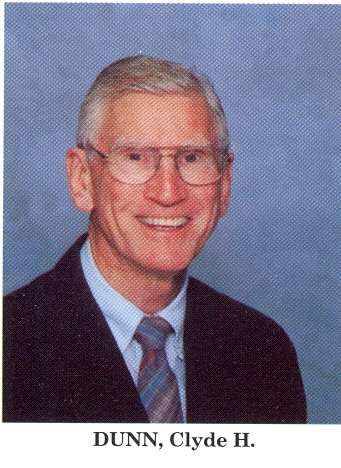
The Rev. Clyde H. Dunn [1997]
“I shall always be grateful that God placed Margaret at Mebane High School for the year 1943-44. That was my senior year.
By the time I was a senior, I had gotten ‘hooked’ on alcohol. I found myself in the predicament of not wanting to drink but unable to give it up. One day, I went to school ‘under the influence’ and the principal discovered my condition. I was immediately expelled, with the condition I would not be allowed to return to school to complete my senior year.
Your mother learned of my situation and sent word by a student for me to come and see her. She saw a potential in me that the principal and other teachers did not. When I met with her, she said that if I would promise to give up drinking, she would do what she could to get me back into school. I promised and she met with the principal and he allowed me to return and finish my senior year. I dread to think how different my life would have been had Margaret Van Hoy not intervened.
Upon graduation, I joined the U. S. Marine Corps. I was converted [to Christianity] at the First Presbyterian Church, in Hollywood, California. I received a call into missionary service at a China Inland Missions Station in Tientsin, China.
After returning from military service, I completed college and seminary. By then the ‘bamboo curtain’ had fallen in China and I was unable to fulfill my missionary calling. I entered the pastorate of the United Methodist Church.
In 1958. an emphasis was put upon service to the ‘Chinese Dispersion’ and we volunteered. We served with the Board of Missions from 1959-1972, mostly on the island of Taiwan. After working ourselves out of a job, by turning over everything to the nationals, we went back into the pastorate here and served until 1993.
I do not think my life would have turned out the way it did if it had not been for your mother. I will always be grateful for her, for the help she gave me, back in 1944.
~~The Rev. Clyde H. Dunn; Raleigh, NC. [Written for my mother’s memorial service: August, 2005.]
Clyde Dunn wrote and published a book about China:
| Title | T.C. Chao’s Struggle for a Chinese Christianity |
| Author | Clyde H. Dunn |
| Contributor | Emory University. Division of Religion |
| Publisher | Emory University, 1974, Division of Religion, Dr. Justo L. Gonzalez., 1974 |
| Length | 240 pages |
| Subjects | China |
Clyde H. Dunn, a student minister from Emory University, was appointed to serve the [United Methodist Church] circuit from 1950-1953. During World War II, Dunn served with the U. S. Marine Corps in the Pacific. John Ben Kelly and his family recalled the time Dunn was spending the night at their home and their three boys, Johnny, Jimmy, and Bobby, got in a pillow fight after Dunn had gone to bed. John Ben kept calling to the boys to be quiet or they would wake the preacher. A little while later, he discovered that Dunn was right in the middle of the pillow fight.



 Margot’s Corner