Category Archives: Advent

Advent Lesson Five: Margot’s Advent Wreath

Dear Family & Friends,

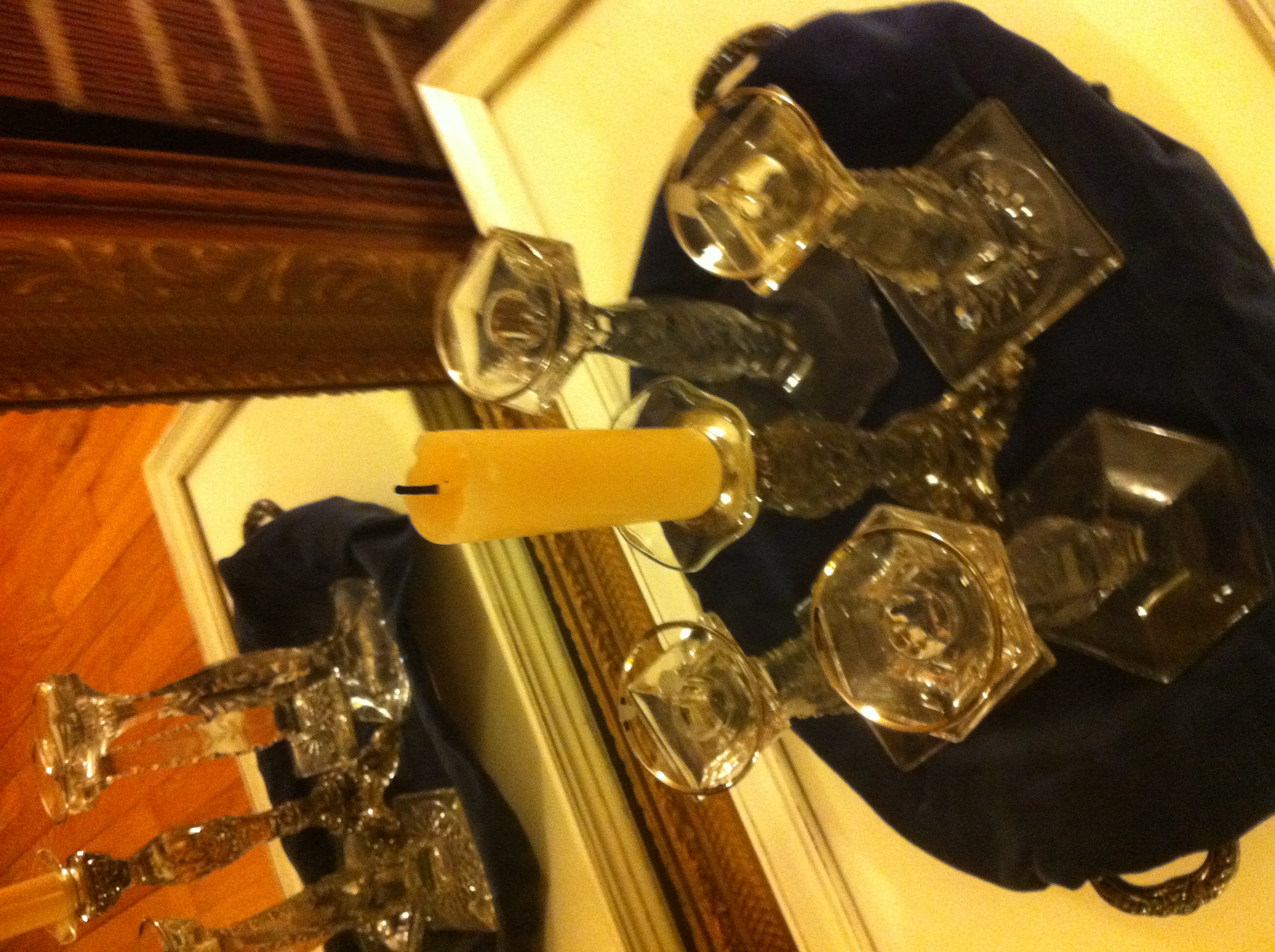
In Advent Lesson Four, we learned about the rich meaning of the Advent Wreath.  Here are photographs and Margot’s Easy Steps to Create an Advent Wreath.  I used a few of my cherished heirlooms and antiques.  I hope this lesson inspires you to use what you already have in your home!

Step One:  Candles

Purchase your Advent Candles ASAP, so that they will arrive by the First Sunday of Advent, which is November 27!  Here is the website:

http://www.toadilyhandmade.com 

You may choose either one Do-It-Yourself Kit [$30: enough to make three sets of five Advent Candles] OR one Already-Made Set [$18 for five Advent Candles].

Each set includes five candles, in three colors: Three Royal Blue OR  Three Royal Purple — plus One Pink plus One Ivory.  When you order, specify “Blue” or “Purple.”

These are 100% pure beeswax candles, which is very important, both for symbolic, aesthetic, and health reasons.  Trust me on this for now.

Step Two: Candlesticks

Search around your home for five complementary candlesticks.  As you see in the photographs, my Advent Wreath includes two sets of matching candlesticks plus one unique single candlestick in the center.  They are all heavy, clear, cut-glass antique candlesticks, circa 1900. You can mix and match candlesticks, in any combination of material [I like silver, pewter, or glass], height, style, and  vintage.

Step Three:  Container

Gather together the candlesticks inside a container — a tray or platter of some sort — any solid, sturdy material will do.  Choose a container that will allow enough room to position the evergreens.  I use a cherished silver serving tray that my mother gave me decades ago. However, I have not yet polished the tray.  So, for this “photo shoot,” I covered the tray with a midnight-blue piece of vintage velvet fabric.

Step Four: Bobeches

Purchase bobeches, which are round, clear-glass “collars,” which catch the candle drips and protect the surface under the candles.  An antique shop should have these.

Step Five:  Evergreens

Go to your locally-owned nursery and ask if you may gather a few evergreen branches that fall onto the ground, between the rows of Christmas trees for sale.  Now you have free evergreens with which to decorate your Advent Wreath!  Do not be fussy about the arrangement:  Trim off the thick, stiff part of the branches.  Overlap the remaining soft, pliable portions, secure them together with thin ribbon, and bend the finished length into a circle, securing the final shape with more ribbon. The color of ribbon should be ivory, blue, or purple.

Step Six:  Display

Decide where to display your Advent Wreath.  I chose the brick hearth:  the space in front of the fireplace, in my living room.  Propped against the front of the fireplace opening, I positioned an antique mirror.  The Advent Wreath sits on the silver tray, which sits upon an off-white painted-wood, over-sized serving tray [hand-made from wood salvaged from antique furniture]. I like the “drama” of the off-white painted-wood against the dark velvet against the clear glass candlesticks.  When the candles are lit, the tableau will reflect off the mirror and looks beautiful! You will have to use your imagination, as I have not yet obtained my Advent Candles, evergreens, or ribbon.

I would love to hear your ideas on creating your Advent Wreath.  After you create your Advent Wreath, you may rest assured that you have “decorated” your home in a meaningful and thoughtful manner.  For several years, I have not displayed any “decor” except my Advent Wreath and Creche.  [Coming up next:  The Creche or Nativity Scene.]
Remember:  The colors of Advent are [primarily] Royal Purple OR Royal Blue plus white or ivory.  I also use silver.
Coram Deo,
Margot

1 Comment

Filed under Advent

Advent Lesson Four: Watch for the Light

The Annunciation:  [hansmemling.org]

The Meaning of Advent and The Advent Wreath

By Fr. Dr. Michael Petty, St. Peter’s Anglican Church, Tallahassee, FL

“[The Season of Advent, within the Church Year,] consists of the four weeks before Christmas Day.  Advent is derived from the Latin word adventus, meaning “coming” or “arrival.” During this season, we have a dual focus in worship:  On the one hand, we anticipate the celebration of Christ’s historical advent or birth in Bethlehem. On the other hand, we anticipate Christ’s final advent, as the world’s Lord and Judge at the end of history. The celebration of Advent helps us to place ourselves within the context of God’s redemptive purposes: We live after the coming of Jesus Christ, as the Messiah promised to Israel, and before the coming of Jesus Christ to bring his work to its ultimate fulfillment.

This season is intended by the Church to help us keep a proper focus during what has become, in our culture, a frenzied time with a heavy commercial emphasis. We spend this season most fruitfully, not by counting down the days to December 25, but by preparing ourselves to celebrate the Incarnation of the Son of God and by amending our lives in the anticipation of his promised return. Advent is a season to slow down, to reflect and to meditate on the great mercies of God. To aid in this process, you may find it useful to read Scripture regularly during this season. Scripture readings for every day of the Advent Season can be found on page 937 and page 939 of The Book of Common Prayer.

The Advent Season comes to an end with the first Eucharist of Christmas, on Christmas Eve. This Eucharist ushers the Church into the Season of Christmas, which lasts until January 6, the Feast of the Epiphany (the Twelve Days of Christmas). Because we observe Christmas as a distinct season, you will notice that we do not make use of Christmas music during Advent.

Advent has been observed by the Church since the sixth century and, over time, many traditions have become associated with the season. One of these traditions is that of the Advent Wreath, a circle of greenery, with four blue candles on the circumference and a white candle in the center. The Advent wreath is a sign of hope; it is greenery displayed during the winter and candles lit, as the days grow shorter.

On each of the four Sundays of Advent a different candle is lit:

The first candle is the Patriarch’s Candle, reminding us of the Old Testament patriarchs who anticipated the fulfillment of God’s promises.

The second is the Prophet’s Candle, reminding us of the Old Testament prophets who foretold the Messiah’s birth.

The third is the John the Baptist Candle, reminding us of the prophet who proclaimed Christ’s Advent.

The fourth is the Virgin Mary Candle, reminding us of Mary’s faithfulness in responding to God’s call to be the Mother of the Messiah.

The final candle, the Christ Candle, is lit on Christmas Eve. As the winter darkness gathers, the light of the Advent Wreath increases and reminds us of the Light of God, shining in the darkness. The lighting of the Advent Wreath is an act of lived hope as the Church remembers Christ’s birth and anticipates his return in glory.”


1 Comment

Filed under Advent

Advent Lesson Three: Keeping Advent as a Counter-Cultural Practice

Keeping Advent as a Counter-Cultural Practice: [Excerpts]

by the Rev. Dr. Michael Petty

St. Peter’s Anglican Church

Tallahassee, Florida

“In the language of the secular world, the Holiday Season [is] marked by its central liturgical action — shopping.  Any serious Christian who has been in a mall at this time of the year knows the strangeness of this experience:  While Christmas Musak plays in the background, frantic [and often very un-merry] people go about the serious American pursuit of consumption.  This is an important clue to what has happened to our culture:  Christianity, real Christianity, has become a sort of background Muzak to what our culture regards as the real business of Christmas, the business of buying stuff.  It may be Jesus’ birthday, but the throne in the mall is occupied by Santa.

. . . the problem is that the way many Christians keep Christmas shows that it is the Church that has been secularized.  The worst thing about the way the Church keeps Christmas is that she has allowed her worship to be secularized and corrupted.  Many churches and many Christians have allowed Christmas to become the fulcrum of their worship life and, in so doing, have allowed their worship life to become secularized and distorted.  We easily forget that the center of Christian faith is not Christmas, but Easter; Christianity is centered in the Paschal Mystery of Jesus’ Death and Resurrection.  The Christian faith is centered not on a generalized feeling of holiday cheer and merry wishes, but around the Death and Resurrection of Jesus Christ. 

. . . The Gospel asserts that our salvation comes not from the cultivation of good will, but from Jesus’ Death on the Cross and His Resurrection to New Life.  When our worship life remains centered on Easter, we are able to see our identity as Christians truly:  we are not primarily consumers or even Americans, but we are people who were buried with Christ in baptism and were raised with Christ through faith in the power of God [Colossians 2:12].

The secular world may have secularized Christmas, but our calling as Christians is to keep our focus on the Good News of Jesus’ Death and Resurrection.  We can do this by keeping the Season of Advent.  While other people have embarked on a frenzy of buying and are trying to be cheerful for no other reason than that it is what you are supposed to do at this time of the year, we are invited to use this time as a period of reflection, meditation, worship and preparation.  During this season, we remind ourselves that the most important thing is not what we will get on December 25, but the Lord to whom we give ourselves in love and worship.  We should keep this season as a time of joyful expectation, not expectation of what will happen on December 25, but expectation of what will happen when Christ returns.  We need to remind our children [and ourselves] that joy is not in the empty boxes of December 25, but in the empty tomb of Easter.  By all means, celebrate Jesus’ birth.  But remember that, without Good Friday, there would be nothing to celebrate.”

Leave a comment

Filed under Advent

Advent Lesson Two: The Gift of Time

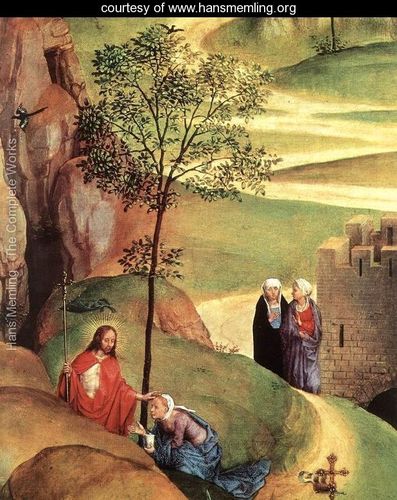
Detail of  “Advent and the Triumph of Christ,” a painting by Hans Memling,  A.D. 1480, which depicts the Life of Christ and the journey through the Church Year,

from Advent to Christmas, from Lent to Easter and Pentecost.

Dear Class,

Welcome to Advent Lesson Two!

Advent Lessons are for anyone who truly desires to “reclaim Advent.”  The lessons are on-line and there is no fee or tuition!  I ask only that you read all the entries, in sequential order.

In Advent Lesson One, we learned that the purpose of the Church Calendar is for God’s people to collectively rehearse and reenact the Grand Drama of Redemption.  Today I will provide some practical tips to assist you, in preparing for the Season of Advent.

Please get out a sheet of three-ring college-ruled paper.  Grab a ruler and a black Sharpie pen.  Draw a “box,” to highlight the margins of the sheet, left, right, top, and bottom.  Inside the box, write the words: “The Gift of the Season of Advent.”     Label the margins,  “Everything Else.”  Post this sheet on your refrigerator or bulletin board.

You have just taken the first step in “reclaiming Advent.”  To properly approach the Season of Advent, we must first view it as a gift which we receive:  It is a treasure, so cherish it, anticipate it, and be thankful!

Please do not view the Season of Advent as yet another “thing” to add to your already-full schedule.  This is the year to receive the gift so — prepare to open a window or door to a  means of grace!

Are you ready for that “breath of fresh air?”  OK, from the list below, add the following dates onto your personal or family calendar:  The Season of Advent, the Season of Christmas, and the Season of Epiphany:  Those are the first three “Acts” in the our corporate reenactment of the Grand Drama of Redemption.  [I have included the entire Church Year, so that you can see it in context.]

I imagine that some of you dear friends are hesitant to continue with the Advent Lessons:  “I just do not have time; maybe next year,” I can hear you saying.  Hmmm . . . may I remind you of the Mystery of Faith?

“Christ has died; Christ is risen; Christ will come again.”

The Mystery of Faith is the irreducible minimum of what Christians believe, of what we corporately believe.  Implied in the Mystery of Faith is the historical fact that Christ has come!  God with us, Emmanuel, the Incarnate God, the Messiah, the Redeemer, the Savior,  the Deliverer has invaded both time and space!

The Mystery of Faith:  Christ has done all of this for us and yet we “just do not have the time” to observe the Season of Advent?

“He who did not spare His own Son but gave Him up for us all, how will He not also with Him graciously give us all things?”  [Romans 8.32, NEV]

All time rightfully belongs to the Triune God.  It is one of the “good things” that He graciously gives to us.  This year, receive the gift of time.  Receive the gift of grace.

Coram Deo,

Margot

The Church Year 2012

These are the major dates of the Christian Church Year for 2011 – 2012, beginning with Advent in 2011.

The Season of Advent (November 27- December 24, 2011)

First Sunday of Advent: November 27, 2011
Second Sunday of Advent: December 4
Third Sunday of Advent: December 11
Fourth Sunday of Advent: December 18

The Season of Christmas (December 25, 2011 – January 5, 2012)

Christmas Day: December 25, 2011
First Sunday of Christmas: December 25, 2011
Second Sunday of Christmas: January 1, 2012

The Season of Epiphany (January 6 – February 21, 2012)

Epiphany: January 6
Baptism of Our Lord: January 8
Transfiguration (Last Sunday in Epiphany): February 19

The Season of Lent (February 25 – April 11, 2012)

Ash Wednesday: February 22
First Sunday in Lent: February 26

Holy Week  (April 1 – April 7 [8], 2012, including Palm/Passion Sunday)

Palm/Passion Sunday: April 1
Maundy Thursday: April 5
Good Friday: April 6
Holy Saturday: April 7

The Season of Easter (April 8 – May 27, 2012, including Pentecost)

Easter Sunday: April 8
Ascension: May 17
Pentecost: May 27

Ordinary Time/Season After Pentecost (May 28 -December 1, 2012)

Trinity Sunday: June 3 (some traditions include with Pentecost)
All Saints Day: November 1
Christ the King: November 25

1 Comment

Filed under Advent

A Gift from My Parents

The First Week of Advent

Dear Readers,

During Advent, I thought you might enjoy hearing about the best gift that I ever received from my parents.  [In this blog, I’ve previously written about and included photographs of my parents.  See The Heroes Among Us:  First in a Series.]

I come from a long line of sacred choral music singers [from Winston-Salem, NC]:  My grandfather, R. E. Blair, was a professional choir member at the downtown Episcopal Church.  My great-grandfather, D. I. Long, was the Choir Master at a Reformed Church, where most of his [eight] adult children sang in the choir, including my grandmother, Hope Susan Long Blair [see The Heroes Among Us:  Second in a Series.]

My father & mother met at Guilford College, NC, while both were in the choir, where they sang a wide range of sacred choral music, under the expert direction of Dr. Ezra Weiss.  For the next three decades, the years they invested in various church choirs provided for my parents some of their richest memories and most lasting friendships.

Once every Advent, my parents performed in Handel’s Messiah Oratorio and we four Blair children attended every performance.  As a young child, I was probably motivated out of a sense of familial duty more than a love of sacred choral music.  However, over the years, I learned to thoroughly enjoy every aspect of the performance:  the libretto, the music, the soloists, the conductor, the instruments, the pipe organ, the candlelight in the church sanctuary, the Advent Chrismon decorations on the evergreen tree — all of it combined to offer a sense of the sublime and majestic!

I suppose a happy mixture of “nature and nurture” bestowed upon me a love of sacred choral music, an ear to appreciate it, and a voice to sing it.  As an adolescent, I enjoyed singing in the church youth choir and in the school choir.  [In the 60’s, you may remember, we sang sacred music in secular schools.]

Now, fast-forward from the 1960’s to 35-40 years later, when Stephen and I began to study theology. It was then that I realized that everything that I knew about theology, up to that point, I had learned from the libretto of Handel’s Messiah Oratorio:  the grand redemption narrative, the prophecies, the integration of the Old and New Testaments, the historical events of the Triune God:  the Creation, Incarnation, Crucifixion, Resurrection, and the Second Coming.

My parents introduced me to Handel’s Messiah Oratorio when I was a child and, over the years, both the music and words shaped and formed my young life, in a gradual inclination of my “heart, mind, soul, and strength” toward knowing and loving the Triune God.

So, every Advent, in my parents’ memory, and for my own enjoyment, I will listen to the complete CD of Messiah and I will participate in the community-wide Messiah Sing.  I may silently weep during part of the Messiah Sing, as I think about my parents.  However, I will be in sympathetic company.  At the 2005 Messiah Sing, the alto sitting next to me whispered, “I may weep a little because I lost my mother this past year.”  I squeezed her hand and whispered, “Me, too.” 

My parents are both gone but their gift to me will continue to benefit me for many years, as I continue to listen, to sing, to study, and to mine the riches and depths of the theology of Messiah!  What a gift!

One of the other “best gifts” I ever received was in 2009, when my daughter, Haley, flew home from Texas, for a three-day visit, with the express purpose of singing with me in the Messiah Sing!  And, so, the best gift from my parents extends to the next generation.  Glory to God!

Coram Deo,

Margo


 Resources for Handel’s Oratorio, Messiah:

  • Book:  Hallelujah: The Bible and Handel’s Messiah, by Carol Bechtel Reynolds, A Resource Book published by the Kerygma Program, 1995.
  • BookHandel’s Messiah Family Advent Reader [The], by Donna W. Payne and Fran Lenzo, Moody Press, 1999.
  • BookMessiah:  The Gospel According to Handel’s Oratorio, by Roger Bullard, Eerdman’s, 1993.
  • CD:  Do It Yourself Messiah CD [The]:  [A choral tutor for your voice:  Order Soprano, Alto, Tenor, or Bass].
  • CDHandel’s Messiah, Robert Shaw, Atlanta Symphony Orchestra & Chamber Chorus, 1984, Telarc, CD-80093.
  • ScoreMessiah Oratorio [Complete] by G. F. Handel, Score, G. Schirmer’s Edition.
  • WebsiteMessiah Sing!  www.tallahasseemusicguild.com.

6 Comments

Filed under Advent, Messiah Oratorio by Handel, theology and doxology