Piercing The Veil: The Search for Meaning

The Search for Meaning:  Interpreting Scripture

Introduction:

From Detectives of Significance:  Sherlock Holmes, Umberto Eco, and the Search for Meaning, by Dr. Louis Markos,  Touchstone Journal, Sept/Oct 2012 issue:

The key thinkers of the Middle Ages valued stability and tradition in their daily lives, but that did not prevent them from setting forth on spiritual, philosophical, and aesthetic quests.

Like the Romantics after them, the Medievals sought to pierce the veil, to discover what lay behind the words, ideas, and images that made up their daily lives . . .

. . . . And that takes us back to the medieval ‘obsession’ with reading poetry in general, and the Bible, in particular, in terms of two or three or four levels of meaning.

 Such a system of reading seems forced and unnatural to us, a mere exercise in obfuscation, but it was not so to them.

 “Interpreting poetry allegorically,” argues Eco, “did not mean  imposing upon it some kind of arid and artificial system.  It meant seeking in it what was felt to be the highest possible pleasure, the pleasure of a revelation ‘per speculum in aenigmate.’ “

Eco borrow the phrase the Latin phrase from 1 Corinthians 13.12:

 ‘For now we see through a glass darkly, but then face to face:  now I know in part, but then shall I know even as also I am known.’

Perhaps no verse in the Bible better explains the impetus behind the medieval quest for higher truths and essenses.  What waits for us on the other side is not just answers, but also Meaning, Purpose, and Presence.

Patristic and Medieval Interpretation of the Four Senses:

From Holy Men and Women of the Middle Ages and Beyond, by Pope Benedict 16, 2012, Ignatius Press, page 31:
  1. Literal or Historical

  2. Allegorical or Christological

  3. Tropological or Moral

  4. Anagogical

The Four Layers of Meaning:  Interpreting Scripture

The Senses of Scripture:

According to an ancient tradition, one can distinguish between two senses of Scripture:  the literal and the spiritual, the latter being subdivided into the allegorical, moral, and anagogical senses.  The profound concordance of the four senses guarantees in all its richness to the living reading of Scripture in the Church.”  [Catholic Catechism, 115]

“A medieval couplet summarizes the significance of the four senses:

‘The Letter speaks of deeds;  Allegory to faith;

The Moral how to act;  Anagogy our destiny.’ ”  [Catholic Catechsim, 117]

Terms and Definitions are from InterVarsity Press Handbook of Theological Terms, unless otherwise noted.

Note:  OT=Old Testament; NT=New Testament

Letter or Literal Sense [Historical]:

The meaning conveyed by the words of Scripture and discovered by exegesis,  following the rules of sound interpretation:  “All other senses of Sacred Scripture are based on the literal.”  [Catholic Catechism: 115]

A strict adherence to the exact word or meaning, either in interpretation or translation, of the Biblical text. 

Attempts to understand the author’s intent by pursuing the most plain, obvious meaning of the text, as judged by the interpreter. 

In translation, the attempt is made to convey with utmost accuracy, through the words of another language, the actual meaning of the biblical text.


Spiritual Sense:  [Allegorical or Christological or Typological]:

Spiritual

An interest or concern for matters of the “spirit,” in contrast to the mere interest and focus on the material.  Christian spirituality, as expressed through participation in certain Christian practices, such as Bible study, prayer, worship, and so forth.

Allegory:

We can aquire a more profound understanding of events by recognizing their significance in Christ; thus the crossing of the Red Sea is a sign or type of Christ’s victory and also of Christian Baptism.  [Catholic Catechism, 117]

Expression, by means of symbolic fictional figures and actions, of truths or generalizations about human existence; a symbolic representation. [Webster’s].

 A story in which the details correspond to or reveal a “hidden,” “higher,” or “deeper” meaning. 

Method of biblical interpretation [which] assumes that biblical stories should be interpreted by seeking the “spiritual” meaning to which the literal sense points.

Christology:

Christology is the study devoted to answering two questions:  Who is Jesus? [the question of his identity] and What is the nature and significance of what Jesus accomplished in the Incarnation? [the question of his work].

Typology:

Differing from a symbol or an allegory, a typology is a representation of an actual, historical reference.  According to Christian exegesis, biblical typology deals with the parallels between actual, historical [usually OT] figures or events in salvation history and their later, analogous fulfillment.  Often NT events and figures are typologically understood and interpreted according to an OT pattern [e.g., Creation and New Creation, Adam and Christ, the Exodus and NT concepts of Salvation.]  On this basis, typology became one of the four prevalent ways [together with the literal, the analogical, and the spiritual] of interpreting Scripture in the Middle Ages.

Moral Sense: [Tropological or Ethical]:

The events reported in Scripture ought to lead us to act justly.  As St. Paul says, they were written “for our instruction.” [Catholic Catechism, 117]

The area of philosophical and theological inquiry into what constitutes right and wrong, that is, morality, as well as what is the good and the good life.  Ethics seeks to provide insight, principles, or even a system or guidance in the quest of the good life or in acting rightly, in either general or specific situations of life. 

Broadly speaking, ethical systems are either deontological [seeking to guide behavior through establishment or discovery of what is intrinsically right and wrong] or teleological [seeking to guide behavior through an understanding of the outcomes or ends that ethical decisions and behavior bring about.]

Anagogical Sense:

Anagog:

[Greek: anagoge, “leading”].  We can view realities and events in terms of eternal signficiance, leading us toward our true homeland:  thus the Church on earth is a sign of the heavenly Jerusalem.  [Catholic Catechism, 117]

Greek:  a “climb” or “ascent” upward.  “Leading above” when by a visible act an invisible is declared.  A method of interpretation of literal statements or events, especially Scripture.  [Wikipedia]

Interpretation of a word, passage, or text, that finds beyond the literal, allegorical, and moral sense, a fourth and ultimate spiritual or mystic sense. [Webster’s]

Orients a person toward eternal life. [Holy Men and Women of the Middle Ages and Beyond, by Pope Benedict 16, 2012, Ignatius Press.]

Interpreting Scripture: Other Terms & Definitions:

Terms and Definitions are from InterVarsity Press Handbook of Theological Terms, unless otherwise noted.

 Analogy of Faith:

 A principle of interpretation that suggests that clearer passages of Scripture should be used to interpret more obscure or difficult passages. 

 For Augustine, the analogy of faith requires that Scripture never be interpreted in such way that it violates the church’s summary of Christian faith [i.e., The Apostle’s Creed]. 

For Luther, Christ is the analogy of faith, so that Scripture needs always to be interpreted as testifying to Christ.

For Calvin, the analogy of faith assumes that, because the Spirit oversaw its writing, Scripture and the Spirit together interpret other parts of Scripture.

Exegesis, Eisegesis:

Literally, “drawing meaning out of” and “reading meaning into,” respectively. 

 Exegesis is the process of seeking to understand what a text means or communicates on its own. 

Eisegesis is generally a derogatory term, used to designate the practice of imposing a preconceived or foreign meaning onto a text, even if that meaning could not have been originally intended at the time of its writing.

Hermeneutics:

The discipline that studies the principles and theories of how texts ought to be interpreted, particularly Sacred texts, such as the Scriptures. 

Hermeneutics also concerns itself with understanding the unique roles and relationships between the author, the text, and the original or subsequent readers.

[Note:  For emphasis, I added italics, bold-face, and other formatting. MBP]


Leave a comment

Filed under Four Levels of Meaning, Interpretation of Scripture, Words & Language

Exploring the Gospel of John: 1

EXPLORING THE GOSPEL OF JOHN

By the Rev. Dr. Michael Petty [Fr. Michael Petty]

St. Peter’s Anglican Church

2006

John 1:1-18

The Prologue to the Gospel

I.  What is a Gospel?

In including four gospels into the canon of Scripture, the Church made a significant decision:  that no one gospel [by itself] could be taken to provide an adequate portrait of Jesus.  One of the earliest Christian theologians, Irenaeus of Lyon, spoke not of four gospels but of a fourfold gospel, the one gospel presented by the fourfold witness of Matthew, Mark, Luke, and John.

The early Church was not at all embarrassed by the fact that the gospels were all slightly different.  The gospels seem to have followed the pattern of ancient biography, the purpose of which was not to present a complete account of the subject’s life, arranging details in chronological order, but to provide an account of the subject’s character and significance.  A major element in this effort was the portrayal of the subject’s death.  Note that John 1:19-12:50 is an account of Jesus’ public ministry, sketched in terms of significant events, and John 13:1-19:42 is an extended account of Jesus’ death.  For John, Jesus is revealed through the signs he performs in the first section and in the way he dies in the second section.  The Prologue to the gospel (1:1-18) is the interpretive key to the whole work.

II. John 1:1-5

1. While Mark begins his account of Jesus with his baptism and while Matthew and Luke begin their accounts with Jesus’ birth, John begins his account of Jesus with the very life of God before Creation.   The reason for this is that Jesus’ relationship to God is one of his primary themes.  The gospels are never concerned with simply providing information about Jesus but they are always concerned with Christologywith understanding who Jesus is as both a person and as one in whom God acts.

2. John’s gospel begins in the very same way that the Septuagint (the Greek translation of the Old Testament) version of Genesis 1:1 begins.   A. Lincoln offers this translation of John 1:1:  “In the beginning was the Word, and the Word was at God’s side, and what God was, the Word was.”   Right from the start, we are given what John considers to be the most important fact about the story of Jesus:  The story of Jesus did not begin in first century Palestine but actually had no beginning at all because he was eternally present with God.  This gospel is going to recount the intersection of time and eternity, human history and the eternal God.

3. “Word  in 1:1 is the English rendering of the Greek word “logos,” a very rich word.   As Word, logos is not simply a conveyor of information but has to do with self-expression.  The Word is God’s own self-expression. While God and his self-expression are distinct, they are not separable.  The basis of John’s Christology is that God expresses himself in the person [of] Jesus.

4.  Two things are in the background here:

One is the fact that, in Genesis 1, God, through speaking, creates realities into existence;  God’s speaking does not merely convey information but actually effects things.  Creation is a Word-formed reality.

Another thing is the role of Wisdom in Proverbs 8, which also is before Creation and is with God.  For the Old Testament, Word (as in Psalm 33:6 and Isaiah 55:11) expresses God’s immanence in Creation, without compromising his transcendence. In Psalm 119: 93, 109, God’s life-giving Word and Wisdom can be identified with Torah, meaning that God’s Torah, given to Israel, was a source of both life and wisdom.  By speaking of Jesus as the Logos, John makes it clear that what is given in Jesus far surpasses what has been given in Torah.  It is not merely that Jesus simply fulfills Scripture (Torah) or completes it but that he surpasses it.

5. The point being made here is not that the Christian revelation is “better” that Judaism.  The purpose of John’s Gospel is not to compare two distinct “religions” called Judaism and Christianity, with a view to showing the superiority of Christianity but to make the case that faith in Jesus as the Word of God is the only true response to Israel’s God, open to both Jews and Gentiles.  Contrary to recent opinion, John is neither anti-Semitic nor anti-Jewish.

6. The relation of the Logos to the created order is both simple and complex:  simple in the sense that “all things were made through him” (1:3) but complex in the sense that the human response to the Word is not uniform (as in 1:9-12).  Colossians 1:15-17 provides a helpful point of comparison:  This gets at the mystery of the person of Jesus, who is both a human being and God’s own self-expression, who gives form and sustenance to the created order.  On one hand, all of creation has a relationship to the Word through its very being; on the other hand, human beings are invited into a relationship to the Word in the person of Jesus through belief.   As 1:4 indicates, the Word is both the source of life (zôe) and light.  God creates through his [Word] and gives revelation through his Word.  Already, we have established the theology, which later Church Councils will have to work out:  that of how the Word is both identified with God and distinct from him.

III: John 1:6-8

1. We abruptly leave eternity to enter into the realm of time and history, so that the coming of the Word can be related to the witness of John (this gospel does not refer to John as “the Baptist”).  Notice that the work of John the forerunner (distinct from the author of the gospel) has its origin in God, as does the work of the Word.

2. Notice that in 1:7 that John “came as a witness, to bear witness.”   Here, we have two of the most important words in this gospel:  witness (marturàia) and bearing witness (marturein).   The noun form is used 14 times in this gospel and the verbal form occurs 33 times.   The purpose of John’s witness is clearly indicated in 1:7.

3. The meaning of witness and bearing witness have a strong meaning in this gospel.  What is envisioned is not simply oral testimony but the totality of one’s life.  It also has a forensic meaning, as in giving testimony in a court.

IV. John 1:9-14

 1. While John the forerunner was to bear witness to the light, Jesus is the light.  The point being made here is that the light Jesus brings is not simply some bit of “religious” knowledge, which is quite nice but which one could do very well without.  The enlightenment brought by the Word is the light of the Truth, the Truth about God, the Truth about human beings, and the Truth about the world.   The Word does not add a bit of religious varnish to a world that is already just fine but, rather, the Word enters into a dark and dying world into order to give light and life.

2. It is worth noting that enlightenment becomes a word for baptism within the New Testament (Ephesians 1:18; Hebrews 10:32) and the writings of the early Church fathers.

3. One type of response to this enlightenment is ironic in 1:10-11.  While the world came into being through the Word and is what it is because of him, it did not know him.  While the Word came to his own people, those most prepared for his coming, they did not recognize him.  This emphasizes the depth of the human predicament:  human beings no longer know who they really are nor do they understand the world for what it really is.

4. 1:12-13 shows another type of response, the response of John’s church.  The Word comes not merely to grant some type of generic enlightenment but to authorize the creation of a new people of God, a people who are children of God, by themselves being reborn.  Being a child of God is not simply a matter of birth (being born into the right people) but a matter of rebirth.   Just as the Word comes from God, so must the rebirth of God’s people.  Note that the problem with Jews, from the standpoint of this gospel, is not that they are Jews (this would be anti-Semitism or anti-Judaism) but the problem is that they have refused what the God of Israel wishes for them.

V. John 1:14-18

 1. In this section, we have the confession of John’s community about the Word.  It begins with the shocking affirmation that “the Word became flesh and dwelt among us (1:14).”   Here we are at the heart of the mystery of Christ who is God’s Word en-fleshed.   In order to begin to understand the mystery of Christ, we have to understand that he is the embodiment of God’s self-expression.  Notice that two seemingly different things come together here:  God’s self-expression and the created order.   In affirming the Incarnation (the en-fleshment of the Word), John affirms that God and creation are not simply opposites.

2. The Word “dwelt among us” (1:14).  This is related to the Old Testament notion of God dwelling among his people, particularly in the tabernacle or Temple (see especially Exodus 40).  It was this dwelling of God that made the Jerusalem Temple so important, in that it was a sacramental sign that God was present to his chosen people.  John holds that Jesus replaces the Temple as God’s place of dwelling.

3. As the new Tabernacle, Jesus the Incarnate Word also reveals God’s glory:  God’s splendor or radiance.  In Exodus 40, it is the glory of God that descends into the tabernacle and dwells.  Glory can also refer to God’s reputation — the weight of God’s name.  In John, it is precisely Jesus’ death [which] reveals the glory of God.  God is glorious, in revealing himself and, in his faithfulness, manifested in his action in Christ.

4. The glory of the Son is that of a Father’s only son (1:14).  In this culture, honor was tied to heredity and a person’s status was tied to that of his father.  The only son in a family had a place of unique honor.  The Son is affirmed to have a unique status because of his unique relationship to his unique Father.

5.  “And from his fullness we have all received, grace upon grace” (1:16):  This statement is looking forward to v.17 and, thus, means that Christ adds to, completes, and surpasses the grace given in the Mosaic Covenant.   The point is not that Jesus and Moses are in competition and that we now have to choose sides nor that “good Jesus” has come to replace “bad Moses” but that what happens in Jesus encompasses Moses but [also] surpasses him.  This, of course, would be the dividing line between Judaism and Christianity.

6. 1:18 refers back to Exodus 33:12-34:9 and the well-known fact that Moses did not see God on Mt. Sinai.  According to Exodus 33:20, it is impossible for human beings to behold God.  And yet, this is precisely what the Son does, by virtue of his very being. The Son is “at the Father’s side”  (or “in the Father’s lap”) and so his vision of God is not an event but part of his very being.  Because the Son knows the Father intimately, he, and he alone, can make him known.  In the Son, we have real revelation, that is God making God known.

Reflection:

The Prologue to John helps us to get a proper sense of perspective, by placing both Jesus and the Church in the larger context of God’s relationship to his creation.  If Jesus is seen simply as a historical figure, questions about why he should be the only way to God immediately pop up and are finally impossible to answer.  When Jesus’ unique relationship with God is set aside, it becomes impossible to justify Christian faith in him other than on the basis of personal preference.  It is only when we make the connection between the historical figure of Jesus and the Son of God, the connection made by the Incarnation, that Jesus as God’s way to God becomes justifiable.

The Christian claim is both radically specific and cosmic at the same time:  It is radically specific in that it insists that God’s Word became Incarnate in a specific, historical person and that this was a unique event.  The salvation of the world does, in a sense, depend upon a Jewish prophet and upon the Israel that gave him birth.

This insistence that an equal opportunity for salvation does not present itself in Buddha or Mohamed is not the result of Christian “intolerance” or “exclusivism” but is the consequence of the way God has acted in his Son.  At the same time, we have to remember that Jesus is not simply a historical figure, knowledge of whom is only available in Scripture or the Church since, as the Word, he is the one through whom the world was created and is the one in whom it is sustained.

The witness of the Church plays an important role but this role presupposes Jesus’ relationship to the whole created order.  This means that the Gospel is not an “inside” story which Christians tell to themselves or a “religion” for those “who like that sort of thing.”  It is, rather, a matter of declaring to the world the truth about itself, a truth which it does not yet know and against which it often unknowingly reacts.  In light of the Prologue, we can see that much of the animus against Christianity is rooted in either the sting that it inflicts, by telling the truth, or the unfaithful way in which some Christians have carried out their task, either being slothful or overzealous.  We can and should do nothing about the former; we are duty-bound to correct the latter.

John 1:19-34

The Testimony of John the Baptist

John 1:19-28

 1.  The atmosphere in this scene anticipates the atmosphere that will surround the whole of Jesus’ public ministry:  that of hostility and interrogation.   John 1:19-34 is about John’s marturía or testimony, where this word has a forensic meaning.   “The Jews” have sent priests and Levites to investigate John’s ministry of baptism (1:25), since they are the experts in purity regulations and baptism had to do with purity.  “The Jews” is used by this gospel to designate a very specific group:  those Jewish officials who oppose Jesus.

2. John is asked about his identity (1:19).  Several things need to be kept in mind, in this respect:

First, we are told that John’s ministry took place in Bethany across the Jordan.  Bethany here is not the Bethany of Mary and Martha, near Jerusalem.  By placing himself across the Jordan, John was signaling some kind of Messianic activity, by suggesting that he was gathering people to be led by the Messiah, across the Jordan into the Promised Land, as Joshua had done but, in this case, what was being symbolized was the creation of a new Israel.

Second, there was no standard Jewish expectation of a Messiah in the first century.  Some Jews (the Sadducees) expected no Messiah at all while others (the Essenes) expected three:  a prophet, a priest and a king.

Third, baptizing Jews was an eschatological action, suggesting some final action on the part of God.

3.  John’s testimony begins with three denials:

(1)  John denies being the Messiah very firmly in 1:20.  “Christ” is simply the Greek version of the Hebrew “Messiah” and becomes the central designation for Jesus.

(2)  John denies being Elijah.  In 2 Kings 2:11, Elijah was taken up into heaven, without dying, and this created, with the help of Malachi 4:5, the popular expectation that Elijah would precede the Messiah.  This denial is in some tension with Mark (1:2) and Matthew (6:14), who do identify John with Elijah. For theological reasons, John pushes the Elijah theme aside, to focus on John solely as one who bears witness to Jesus.

(3)  John denies being the prophet. The prophet here is the one which Jewish interpretation took to be foretold in Deuteronomy 18:15-18, a prophet like Moses.

4.  John’s testimony is not simply one of denial.  In 1:23, he identifies himself with the voice of Isaiah 40:3.  John’s ministry is nothing like that suggested by his interrogators but something far more humble:  that of preparing Israel for God’s intervention.  But this leads to another question:  If John is not the Messiah, Elijah, or the prophet, why is he baptizing?   The question here is not simply one of motive but of authority.  The point of 1:26-27 is to show the subordination of John to Jesus.

The question of why John is baptizing is answered by making it clear that it is simply preliminary — that John is not even worthy to perform for the “one you do not know” (1:26) a function performed by a slave.  The preliminary and subordinate nature of John’s baptism is portrayed in Acts 19:1-6, where there is a distinct separation between “John’s baptism” and baptism “in the name of the Lord Jesus Christ.”

John 1:29-34

 1.   Having been rather tight-lipped about himself, John now has much to say about Jesus.  This, of course, fits the pattern of John as a figure who only makes sense in relation to Jesus and is not an independent object of attention (note 3:30).

2.  John’s positive testimony begins with the affirmation that Jesus is “the Lamb of God who takes away the sin of the world” (1:29).  What does this affirmation mean?  One possible meaning is that Jesus is being identified with the apocalyptic lamb portrayed in inter-testamental Jewish literature, where the lamb is a conquering figure who destroys evil.  This would certainly make sense in light of Revelation 7:17 and in light of John 3:8, where the Son reveals himself to destroy the works of the devil.  Clearly, John’s reference to “lamb” is not intended to designate Jesus as “mild.”

Another possibility is that John is referring to the Suffering Servant Song of Isaiah 52:13-53:12.  This figure’s suffering purifies many (53:6, 11-12) and is described as being like a lamb (53:7).

Another possibility is that John is thinking of the Passover lamb.  This makes sense, in that John alone tells us that Jesus was on the Cross, while the Passover lambs were being slaughtered (19:4).  Of course, all of these images could be intended, putting them into the service of describing Jesus’ definitive role in God’s salvation.

3.  1:30-33 again clearly subordinates John.  While Jesus follows John in the flow of temporal events, this in no way indicates theological priority because, in the sense made clear in 1:1, Jesus is John’s predecessor.  In 1:31-32, we return to the theme of John’s baptism and two important things are made clear:

First, John does not recognize Jesus, until Jesus’ baptism, and only does so because he is told by God to watch for a specific sign.  Notice that this gospel does not actually recount Jesus’ baptism by John but refers to it obliquely (the scene John mentions seems to be Jesus’ baptism, as recounted in Matthew 3:13-17, Mark 1:9-11, and Luke 3:21-22).   Also important to notice is that, in this gospel, the baptism of John is not actually described as being for repentance but rather for the purpose of revealing Jesus to Israel (1:31).

These two things are not in conflict, but by describing John’s baptism in this way, it is made clear that John’s activity has no validity apart from Jesus.

4. In 1:32-33, we are also given an important insight into Jesus’ relation to the Spirit.  In both verses, the Spirit descends upon Jesus and also remains on him.  This sets Jesus’ relation to the Spirit apart from those of other figures who were given the Spirit but upon whom the Spirit did not remain.   It is Jesus’ possession of the Spirit that gives his baptism its unique character (1:33) and enables Jesus to speak of sending the Spirit (16:7).  John 1:32-33 is intimately connected with John 20:22.

5. The scene ends with John summarizing his witness to Jesus:   Jesus is the Son of God.  As Psalm 2:7 indicates, referring to someone as “God’s son” does not necessarily imply that they are divine:  In the case of Psalm 2, the king of Israel is “God’s son.”  But, in light of what John has said about Jesus in 1:29-34, the term takes on a different meaning:  Jesus is the Lamb of God (in several senses), he precedes John in a theological / ontological sense, and he is the one upon whom the Spirit remains.  These affirmations fill out what is meant by “Son of God” in this gospel:  One whose actions are definitive, not simply because he acts on behalf of God (an important claim by itself) but because his actions are also the actions of God.  In this brief scene, we have a summary of this gospel’s Christology.

Reflection:

This account of John’s witness (which will be continued in 3:12-36) provides us with a model for our own witness.  John’s witness is powerful for several reasons:

First, John clearly shifts attention away from himself to Jesus.  His witness is his witness but he is not the principal subject but points beyond himself.

Second, John focuses on conveying a truthful and understandable account of who Jesus is.  The success of a witness depends less on the persuasive abilities of the witness than on the Truth it conveys.  John appears less concerned with getting people to “appreciate” him than with telling the truth he knows.

Third, John appears ready to be questioned and disputed (as he clearly is in 1:19-28) without being discouraged.  “Who Jesus is,” he realizes, is not obvious or a simple truth of common sense:  (If this were the case, no witnesses would be needed!).

Finally, John is able to realize that there is a witness that is greater than his own, a witness which makes his own witness fruitful and this is, of course, the witness of God himself to himself.   It is helpful to see the witness of John as manifesting the ideal balance of characteristics:  It is spirited but does not presume to pound the truth into someone’s mind.  It is convinced but realizes that success does not belong to it.  It is concerned to convey the truth but knows that this truth stands beyond itself.

Leave a comment

Filed under The Gospel of John, theology and doxology

John for Everyone: Syllabus


St. Peter’s Anglican Church [SPAC]
Adult Formation – Wednesday Evening Academy
Fall Semester 2012:  09.12.12 – 12.12.12

Class:  John for Everyone:  Part One & Two

Read:  The Pause That Refreshes
Time:   6.15 pm -7.30 pm
Location:  SPAC Parish House
Leader:  Margot Payne:  marmeepayne@gmail.com   www.margopayne.wordpress.com
 

The Pact:  Present, Prepare, Participate:

I agree to faithfully and diligently [when it is within my power:]
·      Be present and on time every week for class.
·      Prepare for class.
·      Participate in class discussion.
Bring: Bible, John for Everyone, pencil/pen, notebook, clipboard.
Recommended:  Book of Common Prayer 1979 and  Anglican Hymnal 1982.

The Purpose: [Quote from: “The Challenge of Jesus,” by N. T. Wright]

” ‘The Challenge of Jesus’  poses a double-edged challenge:
·      To grow in our understanding of the historical Jesus within the Palestinian world of the first century and
·      To follow Jesus more faithfully into the postmodern world of the twenty-first century.”

 The Presentation:

  • Ancient: Psalms, Hymns, Prayers, Compline, Vespers
  • Sources:  Book of Common Prayer 1979 and Anglican Hymnbook 1982

Resources: Optional

  • The Gospel of John [Wiki]
  • Jewish Holidays [Wiki]
  • Origins:  CNS Documentary Services:  ISSN 0093-609X, “Fides et Ratio,”  John Paul II Encyclical [Brief Synthesis is on the last page].  Email:  CNS@nccbuscc.org, $5 pre-paid.
  • Harper Collins Concise Atlas of the Bible, ISBN 0-06-251499-7, Times Books, London, 1991.
  • Pocket Dictionary of Theological Terms, ISBN 0-8308-1449-3, Grenz, Gunetzki, Nordling, InterVaristy Press, 1999.
  • Music CD:  Compline:  The Shadows of Thy Wing, The Christ Church Choir, Giovanni Pierluigi da Palestrina, Gloria Dei Cantores, 1999, Paraclete Press.

Fall Semester 2012:

09.12.12 Week One:

  • Logistics:  Supper, Books, Contact Info
  • Paradigms & Parameters
  • Worldviews: All Kinds of Lenses! [Box]
  • Hymn:  Immortal, Invisible

Reading Assignment: Due 09.19.12:

Blog entries [see above website]:

09.19.12  Week Two:

Reading Assignments:  Due 09.25.12:  John for Everyone:  Introduction and John 1.
Blog entries:
Reading Assignments:  Due 10.03.12
  • John for Everyone:  John 2.
  • Hymn:  Let All Mortal Flesh Keep Silence
  • Recommended but not required:  Exploring the Gospel of John: 2
     

    10.03.12  — Week Four:

    Reading Assignments:  Due 10.10.12

    Hymn:  Let All Mortal Flesh Keep Silence

  • John for Everyone:  John 3.
  • Recommended but not required:  Exploring the Gospel of John: 3
  •  

    10.10.12 — Week Five:

Reading Assignments:  Due 10.17.12

10.17.12 — Week Six:

Reading Assignments:  Due 10.24.12: [Week Seven]

We will not meet on 10.31.12

Reading Assignments:  Due 11.07.12: [Week Eight]
Reading Assignments:  Due 11.14.12: [Week Nine]
  • John for Everyone:  John 6:  Pages 81-92 in the Commentary.  Read cross-references.
    John for Everyone:  John 7:  Pages 92-99 in the Commentary.  Read cross-references.
  • Hymnody:  “Pange Lingua” [Gregorian Chant]  See: Pange Langua
  • Recommended but not required: Exploring the Gospel of John: 7

    We will not meet on Wednesday, 11.21.12, which is the day before Thanksgiving.

    Reading Assignments:  Due 11.28.12: [Week Ten]

    • John for Everyone:  John 7  in N. T. Wright Commentary.  Read cross-references.
    • Hymnody:  “Pange Lingua” [Gregorian Chant]  See: Pange Langua
    • Recommended but not required: Exploring the Gospel of John: 7

Reading Assignments:  Due 12.05.12: [Week Eleven]

Reading Assignments:  Due 12.12.12: [Week Twelve]

12.12.12 is our last meeting for the Fall Semester.  We meet again on January 16, 2013, after Epiphany.  Check the SPAC website for details.

The Seven Signs of the Gospel of John:

[Seven days – one week of Creation]:

Jesus transforms the water into wine, at the wedding at Cana:  2.1-11

Jesus heals the royal official’s son, in Capernaum:  4.46-54

Jesus heals the paralytic, at the Bethesda pool:  5.1-18

Jesus walks on water, in the Sea of Galilee:

Jesus feeds the 5,000:  6.16-24

Jesus heals the man, who had been blind from birth:  9.1-7

Jesus raises Lazarus from the dead:  11.1-45

[The eighth day – the beginning of the New Creation]:

The Resurrection of Jesus

Coming Up in the Liturgical Calendar:

The First Day of Advent:  12.02.12

Lessons & Carols:  Details:  www.saint-peters.net

Messiah Sing!  Community Sing-A-Long.  Faith Presbyterian Church, 12.06.12, 7.30 pm.

Christmas Eve Worship Service:  December 24, 2012.  Details:  www.saint-peters.net

Christmas Day Worship Service:  December 25, 2012.  Details:  www.saint-peters.net

The Twelve Days of Christmas/Christmastide/Twelvetide:  December 25, 2012 through January 5, 2013:

Twelfth Night/Eve of the Feast of the Epiphany:  January 5, 2013 [Supper at Payne Home, 6.00 PM]

The Feast of the Epiphany:  January 6, 2013

Spring Semester:  Part Two

Coming Up in the Liturgical Calendar:  For details, see http://www.saint-peters.net

Wednesday, 02.13.13:  Ash Wednesday Liturgies:  12.10 pm, 7.00 pm:  NO WED. EVENING CLASSES.

Fridays: 02.18.13 through 03.18.13:  Stations of the Cross:  5.30 pm

Sunday, 03.24.13:  Palm Sunday Liturgy

NO WED. EVENING CLASSES DURING HOLY WEEK [03.27.13]

Thursday, 03.28.13:  Maundy Thursday Liturgy

Friday, 03.29.13:  Good Friday Liturgy

Saturday, 03.30.13:  Easter Vigil, 8.30 pm

Sunday, 03.31.13:  Easter Day/Resurrection Sunday

Sunday, 05.19.13:  Feast of Pentecost

Reading Assignment, due on 01.16.13:

Reading Assignment, due on 01.23.13:

  • John for Everyone:  John 11 in N. T. Wright Commentary.  Read cross-references. 
  • Jot down questions, as you read.  Bring at least one question to the Bible Study.
  • Recommended but not required:   Exploring the Gospel of John: 11.

Reading Assignment, due on 01.30.13:

Reading Assignment, due on 02.06.13:

Post-Discussion Notes:

The Greatest Commandments:

Deuteronomy 6.4-5 contains the “Great Shema,” which means “Hear, O Israel:” 

4   “Hear, O Israel: The Lord our God, the Lord is one.

5    You shall love the Lord your God with all your heart and with all your soul and with all your might.” 

 Leviticus 19.17-18: [ESV]

17    “You shall not hate your brother in your heart, but you shall reason frankly with your neighbor, lest you incur sin because of him.

18    You shall not take vengeance or bear a grudge against the sons of your own people, but you shall love your neighbor as yourself: I am the LORD.”

The Clothing of Humility, Servanthood, Suffering:

Philippians 1:27-2:11 [NASB]

27  Only conduct yourselves in a manner worthy of the gospel of Christ, so that whether I come and see you or remain absent, I will hear of you that you are standing firm in one spirit, with one mind striving together for the faith of the gospel;  28  in no way alarmed by your opponents—which is a sign of destruction for them, but of salvation for you, and that too, from God. 29  For to you it has been granted for Christ’s sake, not only to believe in Him, but also to suffer for His sake, 30 experiencing the same conflict which you saw in me, and now hear to be in me.
1  Therefore, if there is any encouragement in Christ, if there is any consolation of love, if there is any fellowship of the Spirit, if any affection and compassion,  2  make my joy complete by being of the same mind, maintaining the same love, united in spirit, intent on one purpose.  3  Do nothing from selfishness or empty conceit, but with humility of mind regard one another as more important than yourselves;  do not merely look out for your own personal interests, but also for the interests of others.  Have this attitude in yourselves which was also in Christ Jesus,  who, although He existed in the form of God, did not regard equality with God a thing to be grasped,  7  but emptied Himself, taking the form of a bond-servant, and being made in the likeness of men.  Being found in appearance as a man, He humbled Himself by becoming obedient to the point of death, even death on a cross.   9  For this reason also, God highly exalted Him, and bestowed on Him the name which is above every name,  10 so that at the name of Jesus every knee will bow, of those who are in heaven and on earth and under the earth, 11 and that every tongue will confess that Jesus Christ is Lord, to the glory of God the Father.  
Mark 10:42-45 [NASB]
42 Calling them to Himself, Jesus said to them, “You know that those who are recognized as rulers of the Gentiles lord it over them; and their great men exercise authority over them. 
43 But it is not this way among you, but whoever wishes to become great among you shall be your servant;  44 and whoever wishes to be first among you shall be slave of all.  45 For even the Son of Man did not come to be served, but to serve, and to give His life a ransom for many.”

1 Peter 5:5-8 [NASB]:

5  You younger men, likewise, be subject to your elders; and all of you, clothe yourselves with humility toward one another, for God is opposed to the proud, but gives grace to the humble.   6  Therefore, humble yourselves under the mighty hand of God, that He may exalt you at the proper time,  7  casting all your anxiety on Him, because He cares for you. Be of sober spirit, be on the alert.  Your adversary, the devil, prowls around like a roaring lion, seeking someone to devour.
Quote:  “Everyone wants to be considered to be a servant but no one wants to be treated as one.”
We will not meet on 02.13.13 [Ash Wednesday]

Reading Assignment, due on 02.20.13:

Reading Assignment, due on 02.27.13:

Reading Assignment, due 03.o6.13:

Reading Assignment, due 03.13.13:

    • John for Everyone:  John 19 in N. T. Wright Commentary. Read cross-references.   
    • Jot down questions, as you read.  Bring at least one question to the Bible Study.

Reading Assignment, due 03.20.13:

John for Everyone:  John 20 in N. T. Wright Commentary.  Read cross-references.

Jot down questions, as you read.  Bring at least one question to the Bible Study.

Holy Week Hymnody: The Cross of Jesus

We will NOT meet during Holy Week, 03.27.13.

Reading Assignment, due 04.03.13:

John for Everyone:  John 12 in  N. T. Wright Commentary.  Read cross-references.

Jot down questions, as you read.  Bring at least one question to the Bible Study.

On Wednesday, 04.10.13:  6.15 pm to 8.45 pm:

Frances Prevatt has invited us to her home, to view the DVD film, “The Gospel of John,” narrated by Christopher Plummer.

Before the film begins, we will enjoy a simple supper of pizza and salad.


Leave a comment

Filed under The Gospel of John

Worldview Lens: “On the Shoulders of Giants”

The South Rose Window of the Cathedral Notre-Dame de Paris:  [www.notredamedeparis.fr]

La claire-voie de la Rose Sud:  [www.notredamedeparis.fr]

“Under the rosette, the heavenly court is represented by the sixteen prophets, portrayed under the large windows of the bay, which were painted in the 19th century by Alfred Gérente, under Viollet-le-Duc’s supervision.

The architect drew inspiration from Chartres Cathedral, placing the four great prophets (Isaiah, Jeremiah, Ezekiel and Daniel) carrying the four evangelists (Matthew, Mark, Luke and John) on their shoulders, at the centre.

This window echoes the reflections of Bertrand, Bishop of Chartres in the 13th century, on the connection between the Old and New Testaments:

‘We are all dwarves standing on the shoulders of giants.

We see more than they do, not because our vision is clearer there or because we are taller, but because we are lifted up, due to their giant scale.’ ”   

[www.notredamedeparis.fr]

Dear Readers,

[This is a revision from an earlier post.]

Each of us uses his/her own lenses in order to view the world.  This is called a “worldview.”

Since it is impossible to view the world without lenses, it is imperative that we wisely choose the lens that offers us the most clear view of history.

We contemporaries, who are committed to Christian formation, have received a priceless unopened gift — an inheritance!

Receiving this inheritance is like opening the gift of a high-powered, finely engineered telescope, allowing us to peer into the heavens, through a telescope dome:

~~~~~

“Wise Christians should always be historians in one sense.  They sit higher and can see further, more panoramically, if they enrich themselves from the past.

John of Salisbury [1115-1180] a medieval scholar, spoke of the jewels, the riches, the prestige of antiquity.  He was right.  

The past has bequeathed to us its gems.  Note his wise words:

‘Our own generation enjoys the legacy bequeathed to it by that which preceded it.  

We frequently know more, not because we have moved ahead by our own natural ability, but because we are supported by the [mental] strength of others, and possess riches that we have inherited from our forefathers.  

Bernard of Chartres used to compare us to [puny] dwarves perched on the shoulders of giants.  

He pointed out that we see more and farther than our predecessors, not because we have keener vision or greater height, but because we are lifted up and borne aloft on their gigantic stature.’

Our brothers and sisters from the past, indwelt by the same Spirit who indwells us, have left us a rich inheritance.  

It’s locked away inside a treasure chest.  It’s layered in cobwebs.  It’s rusty and in some ways not very appealing.


But inside is the wealth John of Salisbury told us about:  diamonds, emeralds, gold sovereigns, and chains of Spanish silver.  

If you have ever wanted to go on a treasure hunt, you’ve come to the right place.  We’ve already found the chest.  

The hard, laborious work is done.  All we need do is dip our hands inside and let the riches run through our fingers.  

Come along, and you’ll be sitting higher and further.”

[Resource:  Pocket History of the Church, D. Jeffrey Bingham, InterVarsity Press, 2002.]

Coram Deo,

Margot


1 Comment

Filed under discipleship, theology and doxology, Uncategorized, Worldview

Worldview Lens: The Grand Canyon

Dear Readers,

[This is a revision of an earlier post.]

It happened fifty years ago, as our family of six traveled and camped overnight near the Grand Canyon:

In the darkness of early morning, my father roused us from sleep.

We piled into the car and huddled under blankets, as my dad drove us the short distance to the canyon.

Torn away from my warm sleeping bag, I was hungry, for we left before breakfast.

We parked and hiked to the safety railing of the canyon.

I stood, shivering and yawning, waiting for the sun to rise.

The first rays of sunlight exposed only the rim of the canyon.

Very gradually, the sunlight unveiled the upper walls of the canyon, layer upon stratified layer.

Finally, after a long wait, the sunlight  searched out the lower walls of the canyon and, finally, chased away the shadows from the darkest corners of the canyon bed.

We watched in silence, as the sunlight revealed the grandeur, glory, and majesty of the canyon’s colors, textures, and patterns.

I spied the thin ribbon of river, at the bottom of the canyon, a mile below us.

Compared to the giant scale of the canyon, the ribbon seemed insignificant.

Yet, my father told me, it was this same river, a mile deep in ancient times, that thundered and roared through the landscape, to carve out the contours of the canyon.

Incredulous, I surveyed the riverbed and then slowly scanned my eyes up the walls of the canyon, wondering how many centuries elapsed during this process.

I thought to myself,  “What force of nature could be so fearsome and powerful as to carve a canyon a mile high?”

I remember that morning as one of the best gifts that I have ever received:  A once-in-a-lifetime experience.

And I think about that morning every time I read these words:

“I believe in Christianity as I believe that the sun has risen:  not only because I see it, but because by it I see everything else.”  

~~~C. S. Lewis, from The Weight of Glory

Coram Deo,

Margot

Leave a comment

Filed under Childhood Memories, theology and doxology, Worldview

Worldview Lens: Interpreting Scripture

Dear Readers,

Today’s entry continues the Worldview Lens Series:  The entry is long but includes section breaks:   It might be helpful to read one section at a time.

Read this entry slowly and carefully.  It is an excellent introduction to the Art of Interpreting Scripture.

For emphasis, I have included italics, boldface, and underlining.  I have included “Terms and Definitions.”

Written Down to Instruct Us:  Interpreting Scripture

by The Rev. Dr. Michael Petty, St. Peter’s Anglican Church

Introduction

In I Corinthians 10:1-5, Paul makes reference to Israel’s crossing of the Red Sea, the fact that Israel was sustained by miraculous water in the wilderness, and the fact that, while in the wilderness, most of Israel was not faithful to God.  The result of this was that “they were struck down in the wilderness” [I Corinthians 10:5].  Paul presents this whole narrative to the Corinthians church as a warning against taking God’s grace and mercies lightly.  He makes this clear, when he says that these events “were written down to instruct us.” [I Corinthians 10:11]  The significant point made here is absolutely crucial:  Scripture speaks to God’s people, across time.

[There are] two cardinal points with respect to the interpretation of Scripture:

First, we do not begin to truly interpret Scripture, until we allow Scripture to interpret us.  If we are asking all the questions, we are not really interpreting it.

Second, in reading Scripture, we are not simply reading ancient religious literature but God is addressing us.

Interpreting Scripture:  Modern Prejudices

  1. The common perception that the business of biblical interpretation is essentially a war between “fundamentalists” and “liberals” is a mistaken one.  This view is too simplistic.  The real conflict, which takes place as several different [conflicts] simultaneously, is between those who believe that the witness of Scripture is irreplaceable, unsurpassable, and contains the soul of the Christian faith, and those who see Scripture as simply a historically conditioned, human document, which may be set aside at will . . .
  2. The popular view, held by those unfamiliar with the history of biblical interpretation, that the Bible can be interpreted to mean whatever an interpreter wants it to mean, is manifestly false.  If Scripture can be interpreted to mean anything, the consequence is that the Christian faith collapses into meaninglessness.
  3. The view that “modern people” [by which we usually mean ourselves] are so much better equipped to interpret Scripture than [were] past generations of Christians is simply a conceit.  It is quite clear that our scientific and technical education has not brought us to a depth of scriptural understanding which surpasses all previous generations.  One need only look at the quality of modern preaching to see this:  The sermons of St. Augustine, in the fifth century, and the sermons of John Wesley, in the eighteenth, which were all preached to ordinary Christians, reflect deeply on scriptural texts, in ways that are often beyond the average Christian today.  Yet, St. Augustine and Wesley were popular preachers.
  4. With respect to the interpretation of Scripture, [many denominations/churches] suffer from a defect, one that is potentially fatal:  On the one hand, we profess that Scripture is our ultimate authority.  [Article 6 of the Thirty-Nine Articles of Religion says that “Holy Scripture containeth all things necessary to salvation.”]  On the other hand, we have no commonly-recognized way for adjudicating among differing interpretations of Scripture or any real way of articulating normative interpretations.  This means that our claim about Scripture being our ultimate authority is a largely formal one, which has little actual application to our life as a church.

Interpreting Scripture:  Some Historical Perspective

When considering the practice of biblical interpretation, it is important to have some historical perspective.  In particular, we need to mention four points:

1.     It is important to remember that the Christian faith began with the interpretation of Scripture.  For early Christians like Paul, whose letters are the earliest New Testament documents, the Old Testament was not old but simply Scripture [as in 2 Timothy 3:16].  For Paul, the Old Testament is not simply a collection of stories or moral rules but contains God’s designs and promises for his people [Romans 1:1-2], all of which are fulfilled in Jesus Christ [2 Corinthians 1:20].  It is not simply that the Old Testament serves as a good introduction to the New Testament:  Rather, without the Old Testament, the New Testament would not exist.

An example might be helpful:  The first Christians labored to understand the nature and meaning of Jesus’ death on the cross.  Of course, they looked at the cross in the light of the resurrection but they understood both by interpreting the Old Testament.  In Romans 3:23-25, Paul is doing just this.  He describes Jesus as the one “whom God put forward as an expiation of his blood.”  The word translated as expiation or atonement is the Greek work, hilastrion.  Paul is clearly referring to Leviticus 16:2 and the Day of Atonement liturgy, in which the high priest makes atonement or expiation for the sins of Israel, by sprinkling sacrificial blood on the hilastrion or “mercy seat,” the gold lid on the Ark of the CovenantPaul understands that the Day of Atonement finds its fulfillment in Jesus Christ.  The same line of thinking is present in Hebrews 9-10.  The Old Testament provides the matrix, in which Jesus is interpreted.

2.    The fact that the early Christians accepted the Old Testament as Scripture meant that, from the beginning, the so-called “lost gospels,” or Gnostic gospels, could never be accepted as Christian scripture, since these so-called “gospels” were composed by heretical Christian groups, which completely rejected the Old Testament.  The acceptance of the Old Testament as Scripture ruled out, from the beginning, all the Gnostic gospels.  As a matter of fact, no writings produced after 150 AD were even considered for inclusion into the canon of Scripture.

3.    It is important to remember that the Church has been interpreting Scripture for some 2000 years and, in this time, has learned something.  One of the central problems of the modern Church is that, through ignorance and intellectual sloth, we have cut ourselves off from what has been learned.  The Church, as from the beginning, applied two cardinal principles to the interpretation of Scripture.

a.  We must always interpret particular passages of Scripture in the light of the whole Scripture.  What this has meant is that the Old Testament has been interpreted in the light of the New Testament.  The whole of Scripture – Old Testament and New Testament – constitutes a two-testament witness to the one God.  The strength of any interpretation lies in its ability to make sense of Scripture as a unified whole.

b.  We must always interpret passages of Scripture in the light of the Church’s rule of faith, expressed in the ecumenical creeds [The Apostle’s and Nicene Creeds].  We do not read Scripture as we would an encyclopedia [as a neutral source of information] nor do we read Scripture as something whose meaning is determined by the reader.  We read Scripture in the context of the faith, articulated by the Church.

4.  What is now called fundamentalism is a relatively new phenomenon, being essentially a product of the nineteenth century.  It emerged out of the modern context, in which truth was equated with factual information.  Fundamentalism adopted a flattening approach to Scripture, which was really quite new and this resulted in interpretations, which were, surprising though this may sound, rationalistic in nature.  Fundamentalism is a product of the modern world and was one of the many signs that the modern Church had lost touch with its past with respect to the interpretation of Scripture.  The other product of the modern world, Christian liberalism, was equally flawed.  It adopted a way of interpreting Scripture, which was just as flattening as that of fundamentalism, though it was seen as being more congenial to people who considered themselves enlightened.  Both fundamentalism and liberalism are failed methods of biblical interpretation because both decide, in advance, what Scripture can and cannot say.

Christian interpretation of Scripture has always, until recently, recognized that the Bible has many senses and that the art of reading Scripture consists in allowing it to speak from the depth of its riches.

 Traditionally understood, Scripture has been seen as having four senses:

a.  The literal sense:  The plain sense of what the text actually says, as discerned by sound methods of interpretation.  St. Thomas Aquinas thought that this sense was the most important.  To talk about the literal sense of Scripture meant that it had a meaning, which was not simply dependent on the reader.

b.  The allegorical sense:  Some things in Scripture are signs and types of realities in other parts of Scripture.  Scripture contains some truths, which must be understood allegorically.  Example:  Romans 5:12-21.

c.  The moral sense:  Some passages of Scripture must/can be read as offering guidance in holy living.  Example:  1 Corinthians 10.

d.  The anagogical sense:  Some passages of Scripture hold before us our eternal destiny, which is absolutely necessary to our earthly pilgrimage.  Example:  Hebrews 12:18-29.

It is important to note that, for the best Christian interpreters of Scripture, the allegorical, moral, and anagogical sense of Scripture never existed apart from or in conflict with the literal sense.  The four senses of Scripture remind us that the goal of Christian interpretation has been to plumb the depths of Scripture and to present the meaning of Scripture in its entire splendor.  This [approach] contrasts markedly with much of modern interpretation, especially the interpretation in liberal Protestantism, which seems to focus on getting as little out of Scripture as possible or, even, inoculating us against it.  Something is clearly very wrong.  As Pope Benedict XVI [then Cardinal Joseph Ratzinger] noted in his now famous 1988 Erasmus Lecture, the crisis in Biblical interpretation is really a crisis in the faith of the Church.

Interpreting Scripture:  Three Examples:

One of the most important methods of biblical interpretation is called intertextual interpretation.  This method involves paying attention to the ways in which one text of Scripture interprets another.  I want to offer three examples of intertextual interpretation and to show why each is significant.  I will focus on one theme, the New Testament interpretation of the most important event in the Old Testament, the Exodus.  The Exodus is a complex of three events–Passover, Red Sea crossing, and Sinai covenant—and these events constitute the soul of the Old Testament.

1.      “Our God is a consuming fire.”   [Hebrews 12:18-29]:  This text offers a Christian interpretation of Israel’s experience at Mt. Sinai, in Exodus 19:12-22; 20:18-21 [cf. Deuteronomy 4:11-12, 5:22-27].  The experience of Israel becomes the matrix, within which Christians can understand their own experience.  In Jesus Christ, Christians have not simply come to Mt. Sinai, awesome and important as it is.  No, in Jesus Christ, God’s new covenant people, defined no longer by circumcision and Passover, but by Baptism and Eucharist, have come to the city of God, “the heavenly Jerusalem” [12:22].  But note this:  While Christians have come to the heavenly Jerusalem, they have also come into the presence of the same God, Who met Israel on Mt. Sinai.  It is not that Mt. Sinai reveals a God Who is awesome, demanding, and who gives his law to his people to form them in holiness, while Jesus reveals a God who is friendly, undemanding, and who just wants us to be nice.  No, for indeed, our God is a consuming fire [12:29].  God revealed Himself on Mt. Sinai as a consuming fire and remains such, in Jesus Christ.  Those who trifle with God’s grace, who sit loose to His Word, who neglect His holiness, do so to their own eternal peril.  From Jerusalem to New Jerusalem, from Mt. Sinai to Golgotha, God is and remains a consuming fire.  Those who do not take God’s holiness seriously simply cannot understand Scripture.

2.  “Christ, our Passover lamb, has been sacrificed.”  [1 Corinthians 5:7]:  In response to widespread immorality in the Corinthian church, Paul writes, in 1 Corinthians, to make a fundamental point:  that the Corinthians have failed to understand what it means to be the church.  To make this point, Paul interprets the Old Testament, specifically Exodus 12:15-20, which gives instructions for the celebration of the Passover.  During the seven days of Passover, Israel was to eat unleavened bread and all leaven had to be removed from homes.  Anyone who ate leavened bread or whose home had leaven in it was disqualified from keeping Passover.  The removal of leaven was seen as a sign of purity and Leviticus 2:11-16 forbids Israel from offering to God anything with leaven in it.

Paul takes all of this and transposes it into a Christian context.  He reads leaven as moral impurity, Israel celebrating the Passover as the Church celebrating the Eucharist and the Passover Lamb as Christ.  For Paul, therefore, moral impurity is completely inappropriate to the Church, not because this violates a few rules but because it violates the very essence of what the Church is.  Paul uses the Old Testament to make it clear that Christian morality is not simply a matter of individual conduct but a matter of what is appropriate to God’s holy, covenant peopleTo fail to see that the Christian life is essentially about holiness in all dimensions of life is to fail to completely understand God, the Church, and Christ.

3.  “Be perfect, therefore, as your heavenly Father is perfect.” [Matthew 5:48]:  The Sermon on the Mount occupies Matthew 5-7.  It has often been misunderstood.  The most common misunderstanding of it today takes the form of supposing that Jesus came to replace all the hard demands of the Old Testament with easier ones.  Thus, we frequently hear that the essence of Jesus’ teaching is that we should be loving and non-judgmental.  But, listen to what Jesus Himself says:  “Do not think that I have come to abolish the law or the prophets; I have not come to abolish, but to fulfill . . . For I tell you, unless your righteousness exceeds that of the scribes and Pharisees, you will never enter the kingdom of heaven” [Matthew 5:17, 20]

After this, Jesus then reinterprets key commandments of the law.  The prohibition against murder in Exodus 20:13 becomes a prohibition against anger.  The prohibition against adultery in Exodus 20:14 becomes a general prohibition against lust.  The “an eye for an eye and a tooth for a tooth” of Exodus 21:23-24, intended to limit revenge, becomes a command to completely forswear revenge.  The thing to notice here is that, whenever Jesus interprets the Old Testament, he does not interpret it away but interprets it so as to make it more demanding, not less so.  Jesus has not come to free us from God’s demands or to lead us into the sunny uplands of either liberal Christianity or Christian America:  He has come to bring the holiness of God to bear upon every aspect of our lives.  Lest anyone fail to understand what Jesus is driving at, He states his message quite bluntly:

“Be perfect, therefore, as your heavenly Father is perfect.”  [Matthew 5:48]

I close with an analogy from John Henry Newman:  A church which is conformed to upper middle class American consumer culture, a church which is skeptical of Scripture but credulous about itself can no more make proper judgments about Scripture than can a blind person make judgments about shades of color.

 Terms & Definitions [from InterVarsity Press Handbook of Theological Terms, unless otherwise noted.]

[Note: Compiled by Margot Payne.]

Allegory:

Expression, by means of symbolic fictional figures and actions, of truths or generalizations about human existence; a symbolic representation. [Webster’s].

 A story in which the details correspond to or reveal a “hidden,” “higher,” or “deeper” meaning. 

Method of biblical interpretation [which] assumes that biblical stories should be interpreted by seeking the “spiritual” meaning to which the literal sense points.

 Anagog:

Greek:  a “climb” or “ascent” upward.  “Leading above” when by a visible act an invisible is declared.  A method of interpretation of literal statements or events, especially Scripture.  [Wikipedia]

Interpretation of a word, passage, or text, that finds beyond the literal, allegorical, and moral sense, a fourth and ultimate spiritual or mystic sense. [Webster’s]

Analogy of Faith:

 A principle of interpretation that suggests that clearer passages of Scripture should be used to interpret more obscure or difficult passages. 

 For Augustine, the analogy of faith requires that Scripture never be interpreted in such way that it violates the church’s summary of Christian faith [i.e., The Apostle’s Creed]. 

For Luther, Christ is the analogy of faith, so that Scripture needs always to be interpreted as testifying to Christ.

For Calvin, the analogy of faith assumes that, because the Spirit oversaw its writing, Scripture and the Spirit together interpret other parts of Scripture.

Exegesis, Eisegesis:

Literally, “drawing meaning out of” and “reading meaning into,” respectively. 

 Exegesis is the process of seeking to understand what a text means or communicates on its own. 

Eisegesis is generally a derogatory term, used to designate the practice of imposing a preconceived or foreign meaning onto a text, even if that meaning could not have been originally intended at the time of its writing.

Hermeneutics:

The discipline that studies the principles and theories of how texts ought to be interpreted, particularly Sacred texts, such as the Scriptures. 

Hermeneutics also concerns itself with understanding the unique roles and relationships between the author, the text, and the original or subsequent readers.

Literal or Historical:

A strict adherence to the exact word or meaning, either in interpretation or translation, of the Biblical text. 

Attempts to understand the author’s intent by pursuing the most plain, obvious meaning of the text, as judged by the interpreter. 

In translation, the attempt is made to convey with utmost accuracy, through the words of another language, the actual meaning of the biblical text.

 Moral or Ethical:

The area of philosophical and theological inquiry into what constitutes right and wrong, that is, morality, as well as what is the good and the good life.  Ethics seeks to provide insight, principles, or even a system or guidance in the quest of the good life or in acting rightly, in either general or specific situations of life. 

Broadly speaking, ethical systems are either deontological [seeking to guide behavior through establishment or discovery of what is intrinsically right and wrong] or teleological [seeking to guide behavior through an understanding of the outcomes or ends that ethical decisions and behavior bring about.]

 Spiritual:

An interest or concern for matters of the “spirit,” in contrast to the mere interest and focus on the material.  Christian spirituality, as expressed through participation in certain Christian practices, such as Bible study, prayer, worship, and so forth.

Typology:

Differing from a symbol or an allegory, a typology is a representation of an actual, historical reference.  According to Christian exegesis, biblical typology deals with the parallels between actual, historical [usually OT] figures or events in salvation history and their later, analogous fulfillment.  Often NT events and figures are typologically understood and interpreted according to an  OT pattern [e.g., Creation and New Creation, Adam and Christ, the Exodus and NT concepts of Salvation.]  On this basis, typology became one of the four prevalent ways [together with the literal, the analogical, and the spiritual] of interpreting Scripture in the Middle Ages.


1 Comment

Filed under discipleship, theology and doxology, Words & Language, Worldview

Worldview Lens: The Halo Effect

Dear Readers,

Before autumn begins, I have one more story of summer to share with you, from when I was ten [1962] and lived in Bossier City, Louisiana:

Almost every morning, I  hopped on my bicycle and rode across three subdivisions and a corn field.

Finally, I reached the gate of the Barksdale Air Force Base, where my father worked.  From there, I pedaled over to the Officer’s Club Pool, where I parked my bike and met my friends.

[Circa 1960]

All day long, my friends and I played “Marco Polo,” jumped off the diving board, splashed each other, did somersaults, and stood on our heads.  What I chiefly remember is the laughter and the care-free hours.

My friends and I never willingly left the pool water.  However, the lifeguard’s whistle blew every hour, which meant that all the children must exit the pool and “rest” for 10 minutes.

How we resented the sound of that whistle!  We were not tired in the least!

Sometimes we bolted to the concession stand and “nourished” ourselves with French fries and a Coke, while we endured the enforced wait.

After the break, we jumped back into the pool and played, until late afternoon.  Then, I hopped back onto my bike to return home, in time for supper.

Even more delightful than the sun-lit hours were the moon-lit evenings in the pool:  I loved the reflection of the light from the lamps, both above and below the pool.

One evening at the pool, I asked one of my childhood friends:

“Do you see how the lamp-light looks fuzzy, like the moon on a cloudy night?   I mean, you cannot see the lamp itself, right?  You just see a halo?”

For this is [kind of] what I saw:

Or, if I squinted, I might see this:

My young friend looked at me in amazement and silence.  Then, she assured me that she saw no “fuzzy moon” or “halo.”

She described to me how she viewed the lamplight:


I asked every one of my young friends to describe what they saw.  Sure enough, I was the only child in the pool who saw the “fuzzy moons” and the “halos.”

I remember that startling moment, when I realized that I could not trust my own sensory perception. 

I returned home, reported the evening to my parents, and they made an appointment for me to see a professional:  a Doctor of Optometry.

The optometrist determined that my vision was distorted.  Not only was I near-sighted, I also had astigmatism, and my night vision was compromised.

There was, fortunately, a corrective:  frames with prescription lens, which arrived the week following my appointment:

[Children’s eyeglasses, circa 1962]

When I slapped those frames on my face and looked out the lens for the first time, it was a revelation:

The colors, shapes, textures, words, and numbers were now in sharp focus.  Even from across the street, I could identify people and read road signs!

 It was as if I was seeing the world for the first time.  

~~~~~~~~~

Almost 40 years later, in 1999, I had a similar revelation, when N. T. Wright delivered a series of four lectures in Chicago.

Stephen and I were in the audience, with over one thousand graduate students and faculty.  The national conference, entitled “Following Christ:  Shaping Our World” was sponsored by the InterVaristy Christian Fellowship Graduate and Faculty Ministry.

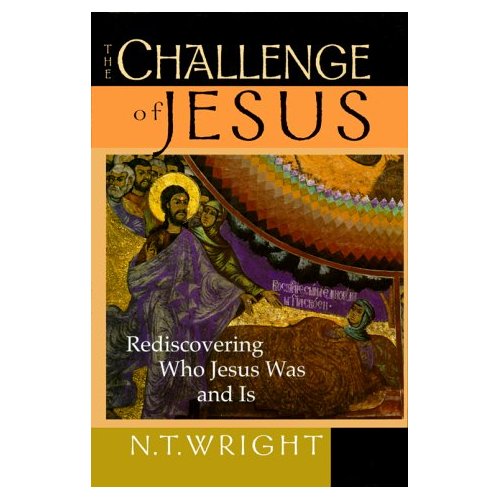
The four lectures formed the backbone of the this book:

Here is a quote from this book . . .

“Out of his own commitment to both historical scholarship and Christian ministry, Wright challenges us to roll up our sleeves and take seriously the study of the historical Jesus.”  [The Publisher]

. . . and a quote from N. T. Wright:

“Many Christians have been, frankly, sloppy in their thinking and talking about Jesus, and hence, sadly, in their praying and in their practice of discipleship.  

We cannot assume that by saying the word “Jesus,” still less the word “Christ,” we are automatically in touch with the real Jesus who walked and talked in first-century Palestine . . . 

. . . Only by hard, historical work can we move toward a fuller comprehension of what the Gospels themselves were trying to say.”

Here is a quote from a more recent book by N. T. Wright . . .

“Bible scholar, Anglican bishop, and bestselling author N. T. Wright summarizes a lifetime of study of Jesus and the New Testament, in order to present for a general audience who Jesus was and is.  

In Simply Jesus, we are invited to hear one of our leading scholars introduce the story of the carpenter’s son from Nazareth, as if he were hearing it for the first time.”  [The Publisher]

. . . and this quote from N. T. Wright:

“Jesus — the Jesus we might discover if we really looked, is larger, more disturbing, [and] more urgent than we had ever imagined.  

We have successfully managed to hide behind other questions and to avoid the huge, world-shaking challenge of Jesus’ central claim and achievement . . . . 

. . . We have reduced the kingdom of God to private piety; the victory of the cross to comfort the conscience; Easter itself to a happy, escapist ending after a sad, dark tale.

Piety, conscience, and ultimate happiness are important, but not nearly as important as Jesus himself.” 

~~~~~~

I will begin teaching a class tonight, at St. Peter’s Anglican Church.  Our text will be The Gospel of John and the commentary will be John for Everyone by N. T. Wright.

Click here for more details: The Pause That Refreshes!

For the objectives of the class, I am borrowing a quote from The Challenge of Jesus:

“The Challenge of Jesus poses a double-edged challenge:

–To grow in our understanding of the historical Jesus within the Palestinian world of the first century, and

–To follow Jesus more faithfully into the postmodern world of the twenty-first century.”  [The Publisher]

Coram Deo,

Margot

2 Comments

Filed under discipleship, The Gospel of John, theology and doxology, Worldview

Portrait of a Template

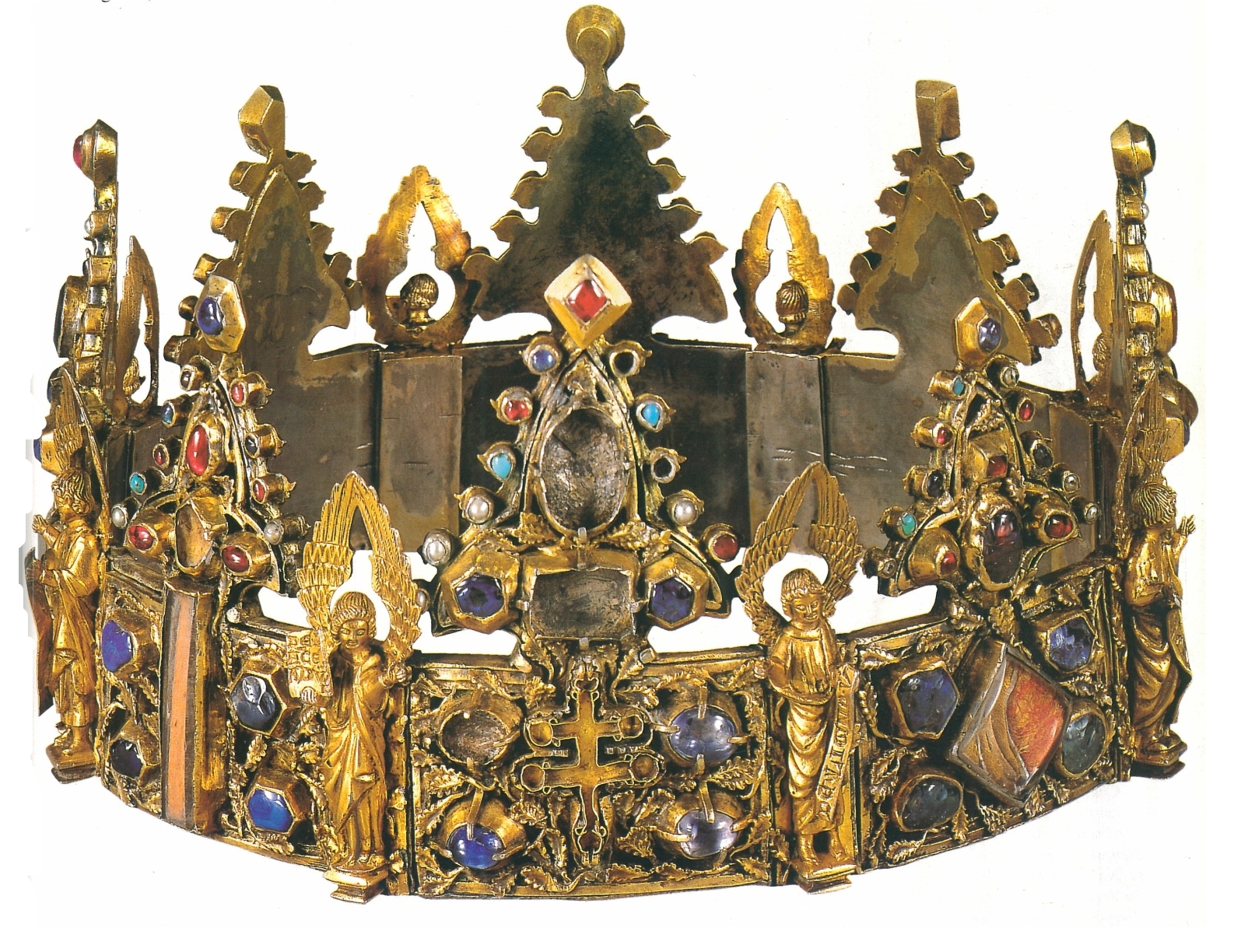
Gottfried Torboch – Jeweled Cruciform Watch with Rock Crystal Case – Walters 5827

Dear Readers,

For several years, I have pondered two great mysteries, abbreviated in two brief phrases:

We are in Christ.   AND    Christ is in us.

Below I have listed, in context, [merely] two of the Scripture passages, which reflect these two great mysteries:

Colossians 1:  24-29

“Now, I rejoice in my sufferings for your sake and, in my flesh, I do my share on behalf of His body, which is the church, in filling up what is lacking in Christ’s afflictions. 

Of this church I was made a minister, according to the stewardship from God bestowed on me for your benefit, so that I might fully carry out the preaching of the word of God, 

that is, the mystery which has been hidden from the past ages and generations, but has now been manifested to His saints, 

to whom God willed to make known what is the riches of the glory of this mystery among the Gentiles, which is Christ in you, the hope of glory. 

We proclaim Him, admonishing every man and teaching every man with all wisdom, so that we may present every man complete in Christ. 

For this purpose also I labor, striving according to His power, which mightily works within me.”

 Colossians 3:1-4  

“Therefore, if you were raised with Christ, look for the things that are above, where Christ is sitting at God’s right side. 

Think about the things above and not things on earth. 

You died, and your life is hidden with Christ in God. 

When Christ, who is your life, is revealed, then you also will be revealed with him in glory.”

~~~

How can two positional realities [Christ in us and We are in Christ] represent one essential truth?

The Crucifixion contains the answer:

“I have been crucified with Christ; and it is no longer I who live, but Christ lives in me; and the life which I now live in the flesh I live by faith in the Son of God, who loved me and gave Himself up for me.” [Galatians 2.20]

It is through the transforming power of the Cross that “we are in Christ” and also that “Christ is in us:”

“Or do you not know that your body is a temple of the Holy Spirit who is in you, whom you have from God, and that you are not your own?  For you have been bought with a price: therefore glorify God in your body.”  [1 Corinthians 6.19-20]

What is our response to the purchase of God, paid on our behalf?

What is our response to the ransom of God:  the payment which freed us from the tyranny of sin and death?

Recognizing that we are no longer “our own,” we are to lead Cruciform lives, in costly obedience.

The shape to which I am conforming must be the Cruciform Life and nothing less:

It is not merely a difficult life; it is an impossible life! [Quote from unknown source].

Yes, impossible, I say — save, that is, for the transforming power of the Resurrected Christ.

I must remain malleable, if I am to be formed, conformed, and transformed into the template of the Cruciform Life.

I must willingly offer myself up as “broken bread and poured-out wine:”  

I offer myself up to be placed within and poured within the shape, the mold, the template of the Cross.

This is the “thanksgiving,” the offering of myself, to the Holy Trinity:  It is “the glad surrender.”

How long does this process, this Cruciform transformation, require?

“My children, with whom I am again in labor, until Christ is formed in you.”  [Galatians 4:19]

“Complete in Christ.”  

“Until Christ is formed in you:”  

How long does this process require?   A lifetime, I think, of  “a long obedience in the same direction.”

Coram Deo,

Margot


dezeen Las Arenas by Rogers Stirk Harbour + Partners -18_1000

Leave a comment

Filed under The Cost of Discipleship, theology and doxology

A Letter from Japan, 1957

Dear Readers,

Please read Summers of Contentment: Part 4, before you read this entry:

Last month, when I visited the NC Blair Family Retreat, I brought home an archival box, labeled, “Japan: 1957.”  Inside the box, in chronological order, are the letters which my father sent back home to my mother in the U. S.  My father wrote frequent letters, during his one-year tour of duty, as the U. S. Air Force commander of a radar base, in the mountains of Hokkaido, Japan.

Yesterday, my husband read aloud to me from the letters this simple sentence, written to my mother:

“Your mention of singing songs in the car made me reminisce — what wonderful, but simple fun we had together riding nowhere in particular and singing out nothing but happiness.”

Read Places of Enchantment, my tribute to my father, which highlights the simple pleasures of family singing, camping, and campfire songs.

Coram Deo,

Margot

Leave a comment

Filed under Family Togetherness, Simple Pleasures

The Sacred and the Mundane

September 2, 1973 – September 2, 2012

Dear Readers,

Tomorrow, My Professor and I will celebrate thirty-nine years of marriage.  Every year, on our wedding anniversary, I share with my readers an essential quote or a story about Courtship, Engagement, Love, or Marriage.

Click here to read the most important quote you will ever read on Love and Marriage, representing the sacramental aspect of marriage.

My story, It Began With Roses, highlights the romance of love and courtship.

In Not a Word, I share with my readers the humor within a marriage.

Sometimes marriage is a serious, solemn commitment, which I describe in  Unsung Heroes.

Marriage is sacred but it is also mundane:

“For all its joys, any intense friendship or marriage has aspects that can seem burdensome.  

There is not only an investment of time, but an investment of self that is required for a relationship to exist and grow and flourish.  

Even more difficult than the physical accommodations are the accommodations of identity:  from the perspective of individual “freedom,” to be in a relationship of love will change us and cost us.  

It will require us to restructure our priorities.  

It may compromise our plans.  

It will demand sacrifice.  

It will alter the pattern of our thoughts and desires and may transform our vision of the world.  

It’s not just ‘your life’ or ‘my life’ anymore — it’s ‘ours.’  

Seen in this light, it can seem that staying at arm’s length and not engaging or investing would seem easier and safer — even if ultimately unhappier — than risking openness to love’s transforming power and answering its claims on us.

Sometimes marriage or other friendships feel euphoric and energizing:  other times, they are tedious, empty, wearying routines, or just plain work.  

The point is that being committed to any love relationship takes daily nurturing, daily effort, and daily practices that build it up.  

Neglecting these will slowly break the relationship down.  

Nurturing grudges or selfish claims instead will erode it and make us resentful of a relationship that now feels like a suffocating trap.  

Kathleen Norris once said that married love is “eternal, but it’s also daily, about as daily and unromantic as housekeeping.”  

It is through daily practices and disciplines, whether we feel like doing them or not, that the decision to love is renewed and refreshed, and the commitment of love is kept alive.”

[From the book, Glittering Vices: A New Look at the Seven Deadly Sins and Their Remedies, by Rebecca Konyndyk DeYoung, Brazos Press, 2009.]

The vocation of Marriage is both sacred and eternal.

But in practical terms, we live out our vocation of Marriage in the daily and mundane.

May we be faithful in living out the vocation of marriage:  “a long obedience in the same direction.”  

Coram Deo,

Margot

1 Comment

Filed under Marriage & Wedding