
Dear Readers,
Before autumn begins, I have one more story of summer to share with you, from when I was ten [1962] and lived in Bossier City, Louisiana:
Almost every morning, I hopped on my bicycle and rode across three subdivisions and a corn field.

Finally, I reached the gate of the Barksdale Air Force Base, where my father worked. From there, I pedaled over to the Officer’s Club Pool, where I parked my bike and met my friends.

[Circa 1960]
All day long, my friends and I played “Marco Polo,” jumped off the diving board, splashed each other, did somersaults, and stood on our heads. What I chiefly remember is the laughter and the care-free hours.
My friends and I never willingly left the pool water. However, the lifeguard’s whistle blew every hour, which meant that all the children must exit the pool and “rest” for 10 minutes.
How we resented the sound of that whistle! We were not tired in the least!
Sometimes we bolted to the concession stand and “nourished” ourselves with French fries and a Coke, while we endured the enforced wait.

After the break, we jumped back into the pool and played, until late afternoon. Then, I hopped back onto my bike to return home, in time for supper.
Even more delightful than the sun-lit hours were the moon-lit evenings in the pool: I loved the reflection of the light from the lamps, both above and below the pool.
One evening at the pool, I asked one of my childhood friends:
“Do you see how the lamp-light looks fuzzy, like the moon on a cloudy night? I mean, you cannot see the lamp itself, right? You just see a halo?”
For this is [kind of] what I saw:

Or, if I squinted, I might see this:

My young friend looked at me in amazement and silence. Then, she assured me that she saw no “fuzzy moon” or “halo.”
She described to me how she viewed the lamplight:

I asked every one of my young friends to describe what they saw. Sure enough, I was the only child in the pool who saw the “fuzzy moons” and the “halos.”
I remember that startling moment, when I realized that I could not trust my own sensory perception.
I returned home, reported the evening to my parents, and they made an appointment for me to see a professional: a Doctor of Optometry.
The optometrist determined that my vision was distorted. Not only was I near-sighted, I also had astigmatism, and my night vision was compromised.
There was, fortunately, a corrective: frames with prescription lens, which arrived the week following my appointment:
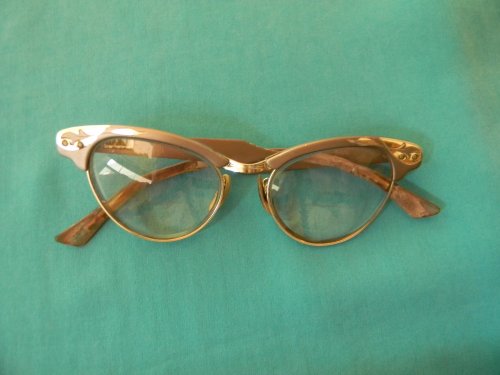
[Children’s eyeglasses, circa 1962]
When I slapped those frames on my face and looked out the lens for the first time, it was a revelation:
The colors, shapes, textures, words, and numbers were now in sharp focus. Even from across the street, I could identify people and read road signs!
It was as if I was seeing the world for the first time.
~~~~~~~~~
Almost 40 years later, in 1999, I had a similar revelation, when N. T. Wright delivered a series of four lectures in Chicago.
Stephen and I were in the audience, with over one thousand graduate students and faculty. The national conference, entitled “Following Christ: Shaping Our World” was sponsored by the InterVaristy Christian Fellowship Graduate and Faculty Ministry.
The four lectures formed the backbone of the this book:
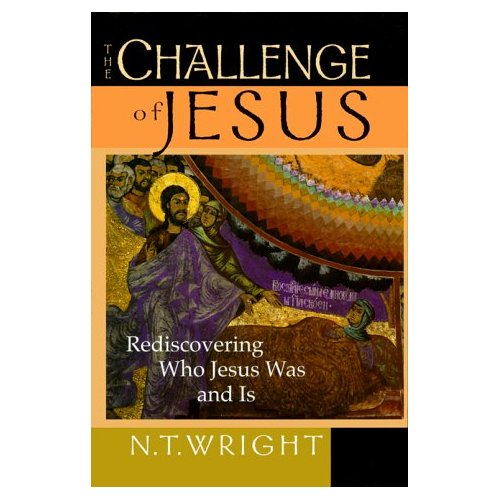
Here is a quote from this book . . .
“Out of his own commitment to both historical scholarship and Christian ministry, Wright challenges us to roll up our sleeves and take seriously the study of the historical Jesus.” [The Publisher]
. . . and a quote from N. T. Wright:
“Many Christians have been, frankly, sloppy in their thinking and talking about Jesus, and hence, sadly, in their praying and in their practice of discipleship.
We cannot assume that by saying the word “Jesus,” still less the word “Christ,” we are automatically in touch with the real Jesus who walked and talked in first-century Palestine . . .
. . . Only by hard, historical work can we move toward a fuller comprehension of what the Gospels themselves were trying to say.”
Here is a quote from a more recent book by N. T. Wright . . .

“Bible scholar, Anglican bishop, and bestselling author N. T. Wright summarizes a lifetime of study of Jesus and the New Testament, in order to present for a general audience who Jesus was and is.
In Simply Jesus, we are invited to hear one of our leading scholars introduce the story of the carpenter’s son from Nazareth, as if he were hearing it for the first time.” [The Publisher]
. . . and this quote from N. T. Wright:
“Jesus — the Jesus we might discover if we really looked, is larger, more disturbing, [and] more urgent than we had ever imagined.
We have successfully managed to hide behind other questions and to avoid the huge, world-shaking challenge of Jesus’ central claim and achievement . . . .
. . . We have reduced the kingdom of God to private piety; the victory of the cross to comfort the conscience; Easter itself to a happy, escapist ending after a sad, dark tale.
Piety, conscience, and ultimate happiness are important, but not nearly as important as Jesus himself.”
~~~~~~
I will begin teaching a class tonight, at St. Peter’s Anglican Church. Our text will be The Gospel of John and the commentary will be John for Everyone by N. T. Wright.
Click here for more details: The Pause That Refreshes!
For the objectives of the class, I am borrowing a quote from The Challenge of Jesus:
“The Challenge of Jesus poses a double-edged challenge:
–To grow in our understanding of the historical Jesus within the Palestinian world of the first century, and
–To follow Jesus more faithfully into the postmodern world of the twenty-first century.” [The Publisher]
Coram Deo,
Margot








 Margot’s Corner
